
Singapore Lightning & Thunderstorm Tracker – Live Storms

- Storms targeting both US coasts threaten to snarl Thanksgiving travel for millions 7:44 PM
- Europe Weather & Natural Hazards Today, Wednesday, November 25, 2026 7:14 PM
- Africa Weather & Natural Hazards Today, Wednesday, November 25, 2026 7:10 PM
- Middle East Weather & Natural Hazards Today, Wednesday, November 25, 2026 7:05 PM
- Australia, New Zealand & Oceania Weather & Natural Hazards Today, Wednesday, November 25, 2026 6:28 PM
- Daily Earthquakes, Storms, Fires & Floods Report, Tuesday, November 24, 2026 6:20 PM
- Weekly Tropical Storm Tracker, Tuesday, November 24, 2026 6:14 PM
- Europe’s Cold Spots This Week: The 10 Coldest Places to Watch, Tuesday, November 24, 2026 6:07 PM
- Western Pacific Tropical Weather Update, Wednesday, November 25, 2026 6:01 PM
- Southwest Indian Ocean Tropical Weather Update – November 25, 2026 5:52 PM
- Australian Region Tropical Weather Update – November 25, 2026 5:14 PM
- Singapore Lightning & Thunderstorms This Week, Wednesday, November 25, 2026 5:05 PM
- Southeast Asia Weather & Natural Hazards Today 4:56 PM




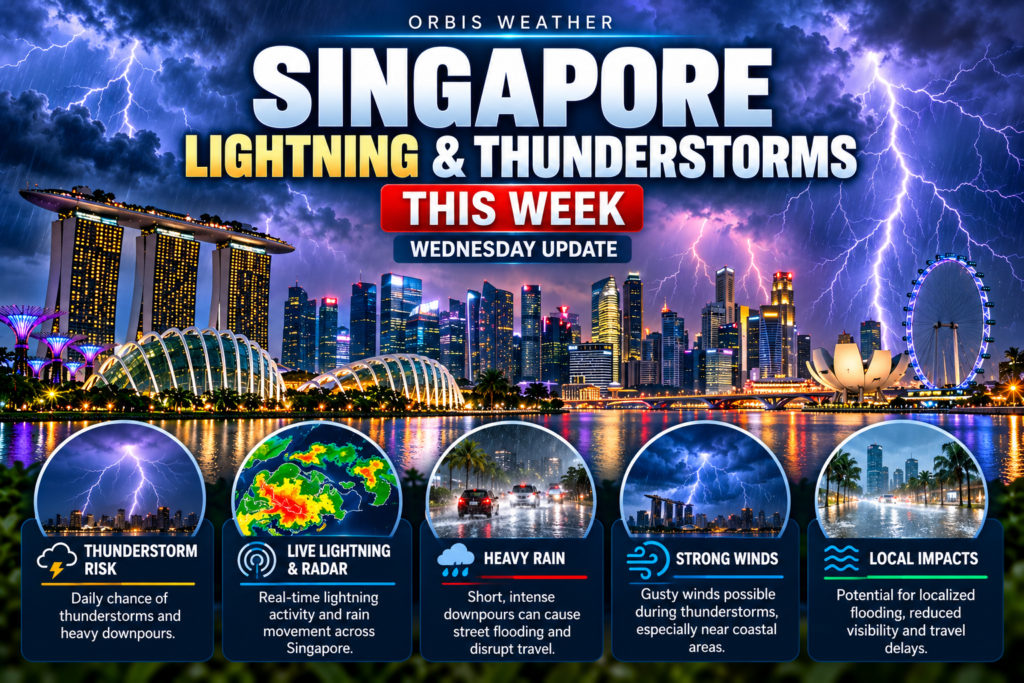
Singapore Lightning & Thunderstorms This Week
Wednesday, November 25, 2026 | Weekly Outlook: November 25 – December 1, 2026
By Paul Harrison | Orbis Weather
Singapore is entering a period of the year when thunderstorms, frequent lightning, heavy tropical downpours and localized flash flooding become increasingly important weather concerns as the Northeast Monsoon season approaches.
Residents, commuters and visitors should remain alert to rapidly changing weather conditions, particularly during the afternoon and evening, when thunderstorms can develop quickly across the island.
⚡ Singapore Lightning & Thunderstorm Risk This Week
The Meteorological Service Singapore (MSS) is forecasting thunderstorms on most days through the remainder of November, with some storms producing widespread heavy rainfall.
Rainfall during the second half of November is expected to be slightly above average across most of Singapore. Northeast Monsoon conditions are also expected to become established.
Weather hazard | Risk assessment |
|---|---|
⚡ Lightning | High during thunderstorms |
⛈️ Thunderstorms | High |
🌧️ Heavy rainfall | Elevated |
🌊 Flash flooding | Elevated |
💨 Strong wind gusts | Possible during storms |
🌡️ Extreme heat | Relatively low |
🚤 Marine thunderstorms | Elevated |
Risk assessments are Orbis Weather editorial assessments, not official warning levels.
📅 Seven-Day Thunderstorm Outlook
Date | Weather outlook | Temperature |
|---|---|---|
Wed, Nov 25 | ⛈️ Late afternoon and evening thunderstorms | 24–34°C (75–93°F) |
Thu, Nov 26 | ⛈️ Afternoon thunderstorms | 24–34°C (75–93°F) |
Fri, Nov 27 | ⛈️ Afternoon thunderstorms | 24–33°C (75–91°F) |
Sat, Nov 28 | ⛈️ Morning thunderstorms | 24–32°C (75–90°F) |
Sun, Nov 29 | 🌧️ Thunderstorms possible | — |
Mon, Nov 30 | ⛈️ Continued thunderstorm potential | — |
Tue, Dec 1 | 🌧️ Seasonal thunderstorm potential | — |
The Wednesday-to-Saturday forecast is based on the official MSS four-day outlook. Sunday and Monday reflect the broader fortnightly forecast, while Tuesday is a seasonal assessment beyond the currently verified forecast period.
⚡ Lightning Risk by Time of Day
Local time | Typical seasonal lightning risk |
|---|---|
6 am – 9 am | 🟡 Moderate |
9 am – Noon | 🟡 Moderate |
Noon – 3 pm | 🟠 Elevated |
3 pm – 6 pm | 🔴 High |
6 pm – 9 pm | 🟠 Elevated |
9 pm – Midnight | 🟡 Moderate |
Midnight – 6 am | 🟢 Generally lower |
Afternoon heating frequently encourages thunderstorm development. However, overnight and morning storms are also possible, particularly as monsoon conditions develop.
These are general seasonal risk patterns rather than hourly lightning predictions.
📍 Areas to Monitor Across Singapore
Thunderstorms can affect every part of the island, including:
Region | Locations |
|---|---|
Northern Singapore | Woodlands, Yishun, Sembawang |
Western Singapore | Jurong, Tuas, Bukit Batok |
Central Singapore | Bukit Timah, Orchard, Bishan |
Eastern Singapore | Changi, Tampines, Pasir Ris |
Southern Singapore | Marina Bay, Sentosa, HarbourFront |
Northeastern Singapore | Punggol, Sengkang, Hougang |
No individual district can be reliably identified as the week’s lightning hotspot from the available forecast.
🌊 Increased Flash Flood Risk November 26–28
One of the most significant weather concerns this week is the possibility of heavy rainfall coinciding with exceptionally high tides.
Singapore’s national water agency, PUB, has highlighted a period of elevated tides between November 26 and 28, when tidal levels are forecast to exceed 3.3 metres.
Heavy rainfall during these high tides could increase the likelihood and severity of flooding in vulnerable coastal and low-lying areas.
Flood alerts were also issued on Tuesday, November 24, for areas around Balmoral Road, Stevens Road, Tanglin Road and Mackenzie Road.
Motorists should avoid driving through flooded roads and monitor official PUB alerts.
🌧️ Northeast Monsoon Update
Singapore is transitioning into the Northeast Monsoon season, which typically continues until March.
The coming weeks could feature:
Frequent tropical downpours.
Periods of intense lightning.
Prolonged rainfall during monsoon surges.
Sudden reductions in visibility.
Localized flash flooding.
Gusty winds associated with thunderstorms.
Hazardous conditions for small boats and recreational marine activities.
A monsoon surge can bring extended periods of rainfall as moisture-laden winds move across the South China Sea toward Singapore and Peninsular Malaysia.
📊 Singapore November Climate Statistics
Based on the official 1991–2020 climate reference period:
Climate indicator | November average |
|---|---|
Monthly rainfall | 252.3 mm (9.93 inches) |
Rainy days | 19 |
Average maximum temperature | 31.2°C (88.2°F) |
Average minimum temperature | 24.6°C (76.3°F) |
Average monthly temperature | 27.2°C (81°F) |
November is historically one of Singapore’s wettest months.
🛑 Lightning Safety Advice
Lightning can strike more than 10 kilometres from its parent thunderstorm, meaning people can be at risk even before rain arrives.
When thunder is heard:
Immediately seek shelter inside a substantial building.
Avoid beaches, swimming pools and open water.
Suspend outdoor sporting activities.
Do not shelter underneath isolated trees.
Avoid exposed rooftops and open fields.
Stay away from metal fences.
Wait at least 30 minutes after the last thunder before resuming outdoor activities.
An umbrella does not provide protection from lightning.
🛰️ Live Singapore Weather & Lightning Monitoring
Residents and visitors should regularly monitor the following official resources:
Meteorological Service Singapore – Official weather forecasts.
Singapore Lightning Information – Lightning observations.
Singapore Rainfall Radar – Tracking developing rainfall.
National Environment Agency – Weather advisories and environmental conditions.
PUB Singapore – Flood alerts and drainage information.
myENV mobile app – Local weather and environmental notifications.
🌍 Orbis Weather Weekly Assessment
Weather factor | Weekly assessment |
|---|---|
⚡ Lightning activity | 🔴 High |
⛈️ Thunderstorm potential | 🔴 High |
🌧️ Heavy rainfall | 🟠 Elevated |
🌊 Flash flooding | 🟠 Elevated |
☀️ Outdoor activity conditions | 🟡 Variable |
🚤 Marine weather conditions | 🟠 Caution advised |
Overall weekly thunderstorm risk: HIGH
Singapore faces another unsettled week, with repeated thunderstorms, potentially intense rainfall and an increased flooding concern between Thursday and Saturday due to high tides.
Outdoor activities should be planned around the latest short-range forecasts, with particular attention to developing afternoon thunderstorms.
About This Report
This weekly Singapore lightning and thunderstorm outlook is compiled by Orbis Weather using official Meteorological Service Singapore forecasts, National Environment Agency advisories, historical climate statistics and reported PUB flood information.
Forecasts and risk assessments are subject to change. This article does not replace official emergency warnings or real-time lightning alerts.
Sources: Meteorological Service Singapore, National Environment Agency, PUB Singapore and AsiaOne.
Published: Wednesday, November 25, 2026 (Singapore Standard Time).
Orbis Weather – Monitoring Weather and Natural Hazards Around the World.
Next 6 Hours
Storm Safety Snapshot
Official & Related Sources
Global Weather Tracker Hub
Explore weather maps, tropical systems, storms and natural hazards around the world.
No matching trackers found.
⚡ Singapore Lightning & Thunderstorm Tracker – Live Storms
Monitor thunderstorms, heavy rain and lightning risk across Singapore with the Orbis Weather Singapore Lightning & Thunderstorm Tracker.
Singapore’s tropical climate creates favorable conditions for thunderstorms throughout the year. Warm temperatures, abundant moisture and strong atmospheric instability can allow storms to develop rapidly, sometimes bringing intense rainfall, frequent lightning and gusty winds within a short period.
The Orbis Weather tracker provides a quick look at current rain, thunderstorm potential, wind and conditions expected during the next several hours.
For official Singapore weather warnings and lightning information, always follow the Meteorological Service Singapore and other appropriate Singapore authorities.
⚡ Why Singapore Gets So Much Lightning
Singapore’s location close to the equator creates an environment highly favorable for thunderstorm development.
Temperatures remain warm throughout the year, while surrounding tropical waters supply large amounts of moisture to the atmosphere.
When warm, humid air rises, it cools and condenses into towering clouds.
If atmospheric conditions are sufficiently unstable, these clouds can develop into powerful cumulonimbus thunderstorms capable of producing torrential rain, strong winds and frequent lightning.
⛈️ How Thunderstorms Form
A thunderstorm generally requires three basic ingredients: moisture, unstable air and a mechanism that causes air to rise.
Singapore regularly has abundant atmospheric moisture.
Strong tropical sunshine heats the surface, encouraging warm air to rise. Sea breezes, regional wind boundaries and other atmospheric features can provide additional lift.
As rising air cools, water vapor condenses and clouds grow vertically.
Strong thunderstorms can eventually extend many kilometres into the atmosphere.
Inside these clouds, powerful updrafts and downdrafts move water droplets and ice particles through the storm.
Electrical charges can separate within the cloud, eventually producing lightning.
🌧️ Why Singapore Thunderstorms Can Produce Intense Rain
Tropical air can contain enormous quantities of water vapor.
When thunderstorms develop, this moisture can condense rapidly and produce very heavy rainfall.
A storm does not necessarily need to last for hours to create problems.
A short but extremely intense tropical downpour can overwhelm drainage systems, produce temporary road flooding and reduce visibility.
This is why rainfall intensity can sometimes be as important as total daily rainfall.
⚡ What Causes Lightning?
Lightning is an enormous electrical discharge.
Inside a thunderstorm, collisions between ice particles, water droplets and other particles help separate electrical charges.
When the difference in electrical charge becomes large enough, electricity rapidly travels between regions of the cloud, between separate clouds or between the cloud and ground.
The resulting electrical discharge heats the surrounding air extremely rapidly.
That sudden heating causes the air to expand explosively, producing the sound we hear as thunder.
🌩️ Cloud-to-Ground vs. In-Cloud Lightning
Not every lightning flash reaches the ground.
A large amount of lightning occurs entirely within clouds or between clouds.
Cloud-to-ground lightning occurs when an electrical discharge connects the storm with Earth’s surface.
Both types can indicate an active thunderstorm.
A storm producing frequent in-cloud lightning can still pose a serious threat because cloud-to-ground strikes may develop at any time.
👂 If You Can Hear Thunder, Lightning Is Close Enough to Matter
Thunder provides a simple warning that lightning is occurring nearby.
Lightning can strike outside the area experiencing the heaviest rain.
That means waiting until rain reaches your exact location before seeking shelter can be dangerous.
If thunder is audible, move to a substantial enclosed building or other appropriate shelter.
Beaches, open fields, exposed coastal areas and isolated trees are poor places to remain during a thunderstorm.
🏝️ Lightning at Singapore Beaches
Singapore’s beaches and coastal areas can become particularly exposed during thunderstorms.
Open beaches provide relatively little protection from lightning.
Swimming should also be avoided when thunderstorms are nearby.
People visiting Sentosa, East Coast Park and other coastal recreation areas should monitor developing weather before and during outdoor activities.
A storm may develop or approach rapidly even when conditions were sunny earlier.
🏗️ Lightning and Outdoor Work
Singapore has extensive construction, port, aviation and outdoor commercial activity.
Workers operating cranes, scaffolding or exposed equipment can face additional risks during thunderstorms.
Outdoor operations should follow appropriate workplace lightning procedures and official safety requirements.
The Orbis Weather tracker can provide general awareness of developing conditions but should not replace professional workplace lightning-warning systems.
🌬️ Thunderstorm Wind Gusts
Lightning and rain are not the only hazards produced by Singapore thunderstorms.
Strong downdrafts can develop when rain-cooled air descends rapidly from a storm and spreads outward near the surface.
These winds can produce sudden powerful gusts.
Loose outdoor objects, temporary structures, tree branches and marine activities can all be affected.
Conditions may deteriorate rapidly as a strong thunderstorm approaches.
💨 What Is a Downburst?
A downburst occurs when a concentrated column of rapidly descending air reaches the surface and spreads outward.
Downbursts can produce damaging straight-line winds.
Smaller, concentrated events are often called microbursts.
Although they are different from tornadoes, powerful downburst winds can still cause damage and create serious aviation hazards.
Heavy tropical thunderstorms are capable of producing these sudden wind events.
🌧️ Thunderstorms and Flash Flooding
Intense thunderstorms can produce large amounts of rainfall in a short period.
When rainfall exceeds the ability of drainage systems to remove water, localized flash flooding can occur.
Roads and low-lying areas may become flooded rapidly.
Never assume floodwater covering a road is shallow enough to drive through safely.
Singapore’s official authorities should always be consulted when heavy-rain or flood warnings are issued.
🌬️ What Is a Sumatra Squall?
One of the most interesting thunderstorm phenomena affecting Singapore is the Sumatra squall.
These organized lines of thunderstorms generally develop over or near Sumatra and move eastward across the Strait of Malacca toward Peninsular Malaysia and Singapore.
They can bring sudden heavy rainfall, frequent lightning and strong gusty winds.
Sumatra squalls can occur during the night or morning, making them different from thunderstorms produced mainly by afternoon heating.
Because they can affect a large area, they are important for aviation, marine operations and outdoor activities.
🌦️ Afternoon Thunderstorms
Many Singapore thunderstorms develop during the afternoon.
Strong daytime heating makes the lower atmosphere increasingly unstable.
Local sea breezes can then interact with winds over the island, helping air converge and rise.
Thunderstorms can develop rapidly once these boundaries interact.
This explains why a hot, relatively sunny morning can sometimes transition into a stormy afternoon.
🌙 Can Singapore Get Thunderstorms at Night?
Yes.
Although daytime heating is an important trigger for many thunderstorms, storms can occur at virtually any hour.
Regional weather systems, Sumatra squalls, monsoon conditions and existing thunderstorm complexes can bring overnight or early-morning storms.
This is another reason not to assume thunderstorms are exclusively an afternoon hazard.
🌧️ Singapore’s Monsoons and Thunderstorms
Singapore experiences two primary monsoon regimes: the Northeast Monsoon and Southwest Monsoon.
The transition periods between them are known as inter-monsoon periods.
Thunderstorm behavior can change with these seasonal wind patterns.
Inter-monsoon periods often feature relatively light winds and strong local heating, creating favorable conditions for afternoon thunderstorms.
The Southwest Monsoon can also produce Sumatra squalls, while the Northeast Monsoon can bring longer periods of widespread rain during monsoon surges.
🌊 Thunderstorms and Marine Conditions
Singapore is surrounded by busy coastal waters.
Thunderstorms can produce lightning, sudden wind shifts, heavy rain and sharply reduced visibility.
These conditions can be dangerous for small boats, kayaks, paddleboards and other recreational watercraft.
Marine conditions can change considerably faster than expected when a strong thunderstorm approaches.
Check current weather and official marine information before heading onto the water.
✈️ Thunderstorms and Changi Airport
Thunderstorms can also affect aviation.
Lightning near an airport can interrupt some ground operations, while heavy rainfall can reduce visibility.
Strong thunderstorm winds can affect aircraft approaches and departures.
Thunderstorms along flight routes may require aircraft to deviate around hazardous weather.
Individual flight status should always be checked directly with the airline or airport.
📡 Weather Radar and Thunderstorms
Weather radar is one of the most useful tools for tracking thunderstorms.
Radar sends energy into the atmosphere and measures signals reflected by precipitation.
This allows meteorologists to identify where rain is occurring and how storms are moving.
Areas of stronger radar returns can indicate heavier precipitation.
Radar does not, however, show every thunderstorm hazard directly.
Lightning observations, wind measurements, satellite imagery and surface observations provide additional information.
⚡ Lightning Tracker vs. Weather Radar
Lightning data and radar complement each other.
Radar primarily shows precipitation and storm structure.
Lightning detection shows electrical activity.
A thunderstorm can produce substantial lightning even when the heaviest rainfall is somewhere else.
Likewise, heavy tropical rain does not always contain large amounts of lightning.
Using both types of information provides a more complete understanding of storm activity.
☔ What Does Rain Chance Mean?
Rain probability estimates the likelihood of measurable precipitation for a particular location and time period.
It does not mean that rain will occur continuously for that percentage of the day.
A 60% rain probability, for example, should not be interpreted as meaning it will rain for 60% of the time.
In tropical climates such as Singapore, thunderstorms can also be highly localized.
One part of the island may experience heavy rain while another remains relatively dry.
📍 Is There a Thunderstorm Near Singapore Right Now?
The Orbis Weather Singapore Lightning & Thunderstorm Tracker provides a quick overview of current precipitation, thunderstorm potential, wind and the next several hours of forecast conditions.
Because tropical storms can develop quickly, conditions should be checked again if you’re planning outdoor activities later in the day.
For official warnings and detailed Singapore observations, use information from the Meteorological Service Singapore.
📊 Understanding the Next 6 Hours
Short-range forecasts can be especially useful for Singapore because of the rapidly changing nature of tropical weather.
The Orbis Weather dashboard displays expected conditions over the next several hours to help visitors identify periods when rain or thunderstorm potential may increase.
Forecasts are not guarantees.
The exact location and timing of individual thunderstorms can be difficult to predict because convective storms can form, strengthen and dissipate rapidly.
🇸🇬 Singapore Lightning Safety
When thunderstorms approach, the safest option is generally to move inside a substantial enclosed building.
Avoid exposed beaches, open fields and isolated trees.
People on the water should return to appropriate shelter before a thunderstorm reaches their location whenever possible.
Do not depend solely on visible rainfall to determine lightning risk.
Lightning can occur beyond the main rain shaft.
🛰️ Where Does Orbis Weather Get Its Storm Data?
The current Orbis Weather Singapore Lightning & Thunderstorm Tracker uses Open-Meteo weather and forecast fields as a live storm indicator.
The Meteorological Service Singapore remains the authoritative source for official Singapore weather observations, forecasts and warnings.
Orbis Weather organizes weather information into a convenient dashboard for general situational awareness but does not issue official Singapore thunderstorm or lightning warnings.
⚡ Monitor Singapore Thunderstorms
Singapore’s tropical environment means thunderstorms can develop quickly throughout the year.
Monitoring rain, lightning potential, wind and short-range forecasts can help residents and visitors better understand changing conditions.
Use the Orbis Weather Singapore Lightning & Thunderstorm Tracker for quick situational awareness and explore the Singapore Weather & Natural Hazards, Singapore Monsoon & Flood Tracker, Singapore Haze & Air Quality Tracker and Southeast Asia Natural Hazards pages for a broader view of conditions across the region.
Important Thunderstorm & Lightning Disclaimer
The Orbis Weather Singapore Lightning & Thunderstorm Tracker is provided for general information, education and situational awareness.
The current browser-based tracker uses Open-Meteo weather information as a storm indicator. It should not be interpreted as an official lightning-detection or warning system. The page itself currently identifies Meteorological Service Singapore as the official reference.
Thunderstorms can develop rapidly, and lightning can occur outside areas of heavy rainfall.
Do not use this tracker alone for life-safety decisions.
Follow Meteorological Service Singapore and Singapore authorities for official warnings and emergency information.