
🌍 Middle East Weather & Natural Hazards Today

- Storms targeting both US coasts threaten to snarl Thanksgiving travel for millions 7:44 PM
- Europe Weather & Natural Hazards Today, Wednesday, November 25, 2026 7:14 PM
- Africa Weather & Natural Hazards Today, Wednesday, November 25, 2026 7:10 PM
- Middle East Weather & Natural Hazards Today, Wednesday, November 25, 2026 7:05 PM
- Australia, New Zealand & Oceania Weather & Natural Hazards Today, Wednesday, November 25, 2026 6:28 PM
- Daily Earthquakes, Storms, Fires & Floods Report, Tuesday, November 24, 2026 6:20 PM
- Weekly Tropical Storm Tracker, Tuesday, November 24, 2026 6:14 PM
- Europe’s Cold Spots This Week: The 10 Coldest Places to Watch, Tuesday, November 24, 2026 6:07 PM
- Western Pacific Tropical Weather Update, Wednesday, November 25, 2026 6:01 PM
- Southwest Indian Ocean Tropical Weather Update – November 25, 2026 5:52 PM
- Australian Region Tropical Weather Update – November 25, 2026 5:14 PM
- Singapore Lightning & Thunderstorms This Week, Wednesday, November 25, 2026 5:05 PM
- Southeast Asia Weather & Natural Hazards Today 4:56 PM





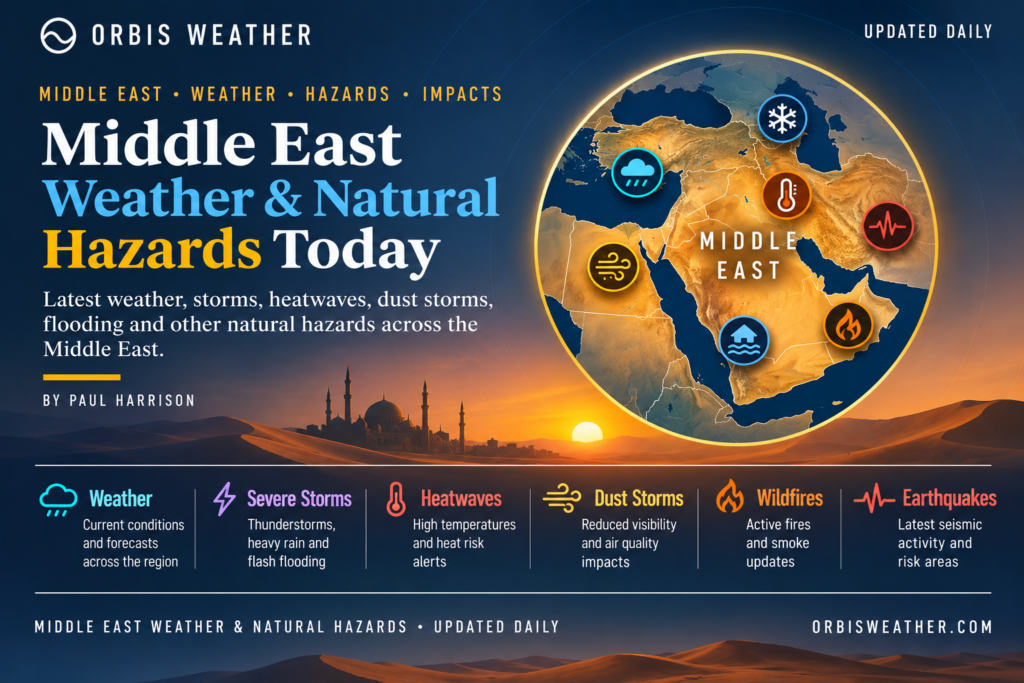
Middle East Weather & Natural Hazards Today
Wednesday, November 25, 2026
By Paul Harrison | Orbis Weather
As November draws to a close, the Middle East enters a period of increasingly varied weather conditions, with cooler temperatures across northern countries, seasonal rainfall risks around the eastern Mediterranean and generally warmer conditions across the Arabian Peninsula.
Flash flooding, desert dust, mountain snowfall and seismic activity remain important natural hazards to monitor across the region.
🌍 Today’s Main Weather & Natural Hazard Headlines
🌧️ United Arab Emirates: Light rainfall forecast across some coastal and western areas.
🌫️ Arabian Peninsula: Overnight humidity and localized fog remain concerns.
🌍 Türkiye: Magnitude 4.6 earthquake recorded near Milas on November 24.
❄️ Northern Middle East: Seasonal snowfall remains a concern across higher mountain elevations.
🏜️ Desert regions: Blowing dust and reduced visibility remain potential hazards.
🌊 Arabian Gulf: Slight to occasionally moderate sea conditions forecast near the UAE.
🇦🇪 United Arab Emirates
The UAE’s National Centre of Meteorology is forecasting periods of cloud cover and possible light rainfall from Wednesday through Saturday, particularly across islands, western districts and some coastal communities.
Location | Forecast high | Forecast low |
|---|---|---|
Dubai | 86°F (30°C) | 73°F (23°C) |
Abu Dhabi | 88°F (31°C) | 72°F (22°C) |
Ras Al Khaimah | — | 64°F (18°C) |
Winds could occasionally reach 22 mph (35 km/h), while increasing overnight humidity may produce fog and mist. Temperatures are expected to decrease on Thursday.
🇸🇦 Saudi Arabia
Late-November conditions typically bring comfortable daytime temperatures and considerably cooler nights across central and northern Saudi Arabia.
Seasonal hazards to monitor include:
Blowing dust across exposed desert highways.
Localized thunderstorms along western mountain ranges.
Flash flooding in wadis during intense rainfall.
Reduced visibility during dust events.
🇴🇲 Oman
Oman’s principal seasonal weather hazards include coastal humidity, isolated mountain thunderstorms and localized flooding following heavy rainfall.
Residents and visitors exploring mountainous areas should remain alert to rapidly changing conditions and avoid entering flooded wadis.
🇶🇦 Qatar, 🇧🇭 Bahrain & 🇰🇼 Kuwait
Late autumn generally brings more comfortable temperatures across the northern Arabian Gulf.
Potential hazards include early-morning fog, reduced road visibility, occasional dust and stronger northwesterly winds associated with seasonal weather fronts.
🇮🇶 Iraq
Iraq is entering its wetter and cooler winter season, with northern mountainous areas particularly susceptible to rainfall and colder overnight temperatures.
Urban flooding, poor drainage and rapidly rising water levels in low-lying areas remain concerns whenever substantial rainfall develops.
🇮🇷 Iran
Iran’s varied geography produces significant seasonal temperature differences between the warmer southern coast and the colder northern and western mountains.
Natural hazards to monitor include mountain snowfall, icy roads, earthquakes, localized flooding and urban air pollution.
🇹🇷 Türkiye
Türkiye remains vulnerable to autumn and early winter weather systems, particularly along the Black Sea coast and across mountainous eastern districts.
🌍 Earthquake Report
The European-Mediterranean Seismological Centre recorded a felt earthquake in southwestern Türkiye on Tuesday.
Earthquake details | Information |
|---|---|
Magnitude | 4.6 |
Date | November 24, 2026 |
Local time | 6:39 p.m. |
Location | 21 km southeast of Milas |
Depth | 10 km |
Smaller subsequent earthquake | Magnitude 2.8 |
The earthquake generated numerous public shaking reports. Damage and injury information has not been independently verified.
🇮🇱 Israel, 🇵🇸 Palestinian Territories, 🇱🇧 Lebanon, 🇸🇾 Syria & 🇯🇴 Jordan
The eastern Mediterranean is entering its traditional winter rainfall season.
Periodic Mediterranean weather systems can bring heavy showers, thunderstorms, cooler temperatures and localized flooding.
Communities with damaged infrastructure, inadequate drainage and temporary shelters are particularly vulnerable during periods of heavy rainfall and cold overnight conditions.
🇾🇪 Yemen
Yemen remains susceptible to localized flash flooding, particularly around mountainous communities and dry river valleys.
Coastal areas may experience significantly warmer temperatures than inland highland communities.
🌀 Arabian Sea Tropical Weather Outlook
November falls within the North Indian Ocean’s post-monsoon cyclone season.
Although tropical cyclone activity typically becomes less frequent as December approaches, conditions across the Arabian Sea can still support tropical development.
No current tropical cyclone status has been independently verified for this edition. Coastal residents should monitor official advisories from the India Meteorological Department.
⚠️ Regional Natural Hazard Watch
Natural hazard | Areas of particular vulnerability |
|---|---|
🌧️ Heavy rainfall | Eastern Mediterranean, Arabian mountain ranges |
🌊 Flash flooding | Yemen, Oman, Saudi Arabia, Iraq |
🌍 Earthquakes | Türkiye, Iran, Iraq |
🌫️ Dust storms | Saudi Arabia, Kuwait, Iraq |
❄️ Snow and ice | Türkiye, Iran, northern Iraq |
🚗 Fog | UAE and Arabian Gulf countries |
🌀 Tropical cyclones | Arabian Sea |
This table identifies seasonal vulnerabilities rather than active official weather warnings.
📅 Outlook: November 26–28
The UAE could experience several days of intermittent light rainfall, increasing overnight humidity and slightly cooler temperatures.
Elsewhere, seasonal weather monitoring should focus on Mediterranean rainfall systems, mountain temperatures, desert visibility and Arabian Sea tropical activity.
📡 Official Weather & Natural Hazard Monitoring Sources
🌐 Orbis Weather Summary
Light rainfall across parts of the UAE and the recent magnitude 4.6 earthquake in southwestern Türkiye are among the confirmed developments featured in Wednesday’s Middle East report.
Seasonal flooding, dust storms, mountain snowfall and seismic activity remain important hazards to monitor as the region approaches December.
Editorial note: This early-morning edition combines verified UAE forecasts and recent seismic observations with broader seasonal hazard guidance. Live country-by-country forecasts and active warnings were not independently verified for every location. Readers should consult their national meteorological and emergency management authorities before making weather-sensitive decisions.
Orbis Weather — Monitoring Our Planet, One Day at a Time.
About the Author
Paul Harrison — Founder & Publisher, Orbis Weather
Paul Harrison founded Orbis Weather in 2026 to make global weather and natural-hazard information easier to find, follow and understand. His coverage includes tropical cyclones, severe weather, extreme temperatures, earthquakes, volcanoes, wildfires, flooding and significant natural disasters worldwide.
View all articles by Paul Harrison → | Editorial Standards →
Global Weather Tracker Hub
Explore weather maps, tropical systems, storms and natural hazards around the world.
No matching trackers found.