
🌍 Australia, New Zealand & Oceania Weather & Natural Hazards Today

- Storms targeting both US coasts threaten to snarl Thanksgiving travel for millions 7:44 PM
- Europe Weather & Natural Hazards Today, Wednesday, November 25, 2026 7:14 PM
- Africa Weather & Natural Hazards Today, Wednesday, November 25, 2026 7:10 PM
- Middle East Weather & Natural Hazards Today, Wednesday, November 25, 2026 7:05 PM
- Australia, New Zealand & Oceania Weather & Natural Hazards Today, Wednesday, November 25, 2026 6:28 PM
- Daily Earthquakes, Storms, Fires & Floods Report, Tuesday, November 24, 2026 6:20 PM
- Weekly Tropical Storm Tracker, Tuesday, November 24, 2026 6:14 PM
- Europe’s Cold Spots This Week: The 10 Coldest Places to Watch, Tuesday, November 24, 2026 6:07 PM
- Western Pacific Tropical Weather Update, Wednesday, November 25, 2026 6:01 PM
- Southwest Indian Ocean Tropical Weather Update – November 25, 2026 5:52 PM
- Australian Region Tropical Weather Update – November 25, 2026 5:14 PM
- Singapore Lightning & Thunderstorms This Week, Wednesday, November 25, 2026 5:05 PM
- Southeast Asia Weather & Natural Hazards Today 4:56 PM





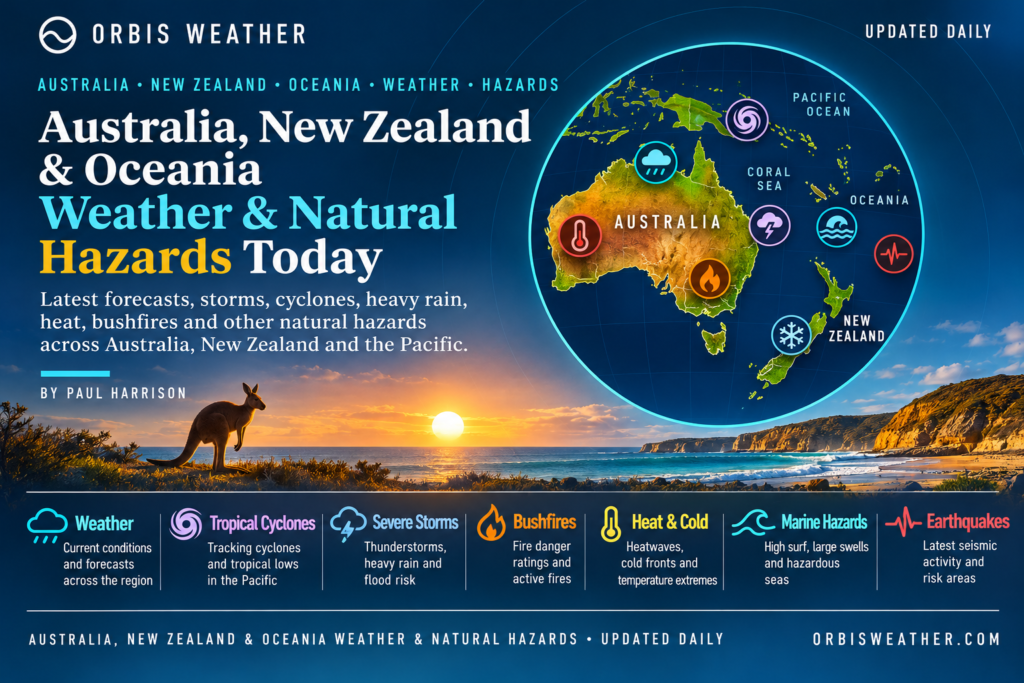
Australia, New Zealand & Oceania Weather & Natural Hazards Today
Wednesday, November 25, 2026
By Paul Harrison | Orbis Weather
Australia, New Zealand and the Pacific Islands are approaching the beginning of meteorological summer, with tropical cyclone activity, severe thunderstorms, extreme heat, flooding and bushfire risks becoming increasingly important across the region.
The Southern Hemisphere tropical cyclone season is now underway, while New Zealand remains susceptible to rapidly changing weather systems moving across the Tasman Sea.
Today’s regional report covers tropical weather, severe storms, rainfall, earthquakes, volcanic activity, bushfires and marine hazards across Australia, New Zealand and Oceania.
🌏 Regional Weather & Natural Hazards at a Glance
Region | Main weather concern | Monitoring priority |
|---|---|---|
🇦🇺 Northern Australia | Heatwaves and thunderstorms | 🟠 Elevated |
🇦🇺 Western Australia | Extreme heat | 🟠 Elevated |
🇦🇺 Queensland | Heat and tropical rainfall | 🟠 Elevated |
🇳🇿 New Zealand | Rain, thunderstorms and strong winds | 🟡 Moderate |
🇵🇬 Papua New Guinea | Seasonal rainfall and seismic activity | ⚪ Monitoring |
🇫🇯 Fiji | Seasonal tropical weather | ⚪ Monitoring |
🇼🇸 Samoa | Former Cyclone Xavier | 🟡 Monitoring |
🇹🇴 Tonga | Seasonal tropical weather | ⚪ Monitoring |
🇻🇺 Vanuatu | Earthquake and volcanic monitoring | ⚪ Monitoring |
🇨🇰 Cook Islands | Cyclone Xavier recovery | 🟠 Elevated |
🇳🇨 New Caledonia | Seasonal tropical weather | ⚪ Monitoring |
Monitoring priorities are editorial assessments, not official warning levels.
🇦🇺 Australia Weather Today
🌡️ Extreme Heat Across Northern Australia
The Australian Bureau of Meteorology’s November 24 Tropical Climate Update confirms that heatwave conditions have affected northern Queensland, the Northern Territory and northern Western Australia.
Several areas have recently experienced temperatures exceeding 104°F (40°C).
Weipa Airport in Queensland recorded its highest-ever daily maximum temperature on November 19.
40.4°C
104.7°F
19 days
New local record⛈️ Northern Territory Thunderstorms and Heavy Rainfall
Recent tropical thunderstorms have delivered substantial rainfall across the Northern Territory.
Bulman recorded 181.8 mm (7.16 inches) of weekly rainfall, including 177.8 mm (7 inches) within a single 24-hour period ending November 20.
The Bureau of Meteorology anticipates above-average rainfall across substantial portions of Queensland and the Northern Territory between November 28 and December 11.
Potential hazards include localized flash flooding, dangerous lightning, damaging wind gusts and hazardous driving conditions.
Australian Regional Monitoring
State or territory | Weather hazards to monitor |
|---|---|
Western Australia | Heatwaves and thunderstorms |
Northern Territory | Heavy tropical downpours and extreme heat |
Queensland | Heatwaves and increasing rainfall |
New South Wales | Seasonal thunderstorms and bushfire conditions |
Victoria | Changing temperatures and frontal systems |
South Australia | Heat and bushfire conditions |
Tasmania | Strong winds and passing weather fronts |
Australian Capital Territory | Seasonal thunderstorms |
The southern Australian entries represent seasonal monitoring priorities rather than verified November 25 forecasts.
🌀 Australian Tropical Cyclone Outlook
The 2026–2027 Australian tropical cyclone season is officially underway and continues until April 30, 2027.
The Pacific Disaster Center’s November 24 report identified no active tropical cyclones across the Western Pacific and Indian Ocean but highlighted two developing disturbances in the South Indian Ocean.
Tropical system | Development potential |
|---|---|
Invest 97S | 🟡 Medium within 24 hours |
Invest 98S | 🟠 High within 24 hours |
Both disturbances are located near the Diego Garcia region, well to the west of mainland Australia. No direct Australian landfall threat has been established from these systems.
🇳🇿 New Zealand Weather Today
🌧️ Rain and Thunderstorms Across the South Island
A frontal system is forecast to move northward across New Zealand’s South Island on Wednesday, with a low-pressure system developing east of Canterbury during the evening.
The November 25 thunderstorm outlook identifies a low probability of thunderstorms across parts of Fiordland, southern Westland and coastal Canterbury.
Region | Weather outlook |
|---|---|
North Island | Generally minimal thunderstorm risk |
Fiordland | Rain and possible thunderstorms |
Westland | Showers and possible thunderstorms |
Canterbury | Evening thunderstorm potential near coastal areas |
Otago | Rain and possible strong winds into Thursday |
Southland | Changing frontal weather conditions |
Chatham Islands | Approaching offshore low-pressure system |
📅 New Zealand Extended Outlook
Day | Expected weather pattern |
|---|---|
Wednesday, November 25 | South Island frontal system |
Thursday, November 26 | Rain and possible southwest gales in southeastern areas |
Friday, November 27 | High pressure develops |
Saturday, November 28 | More settled conditions |
Sunday, November 29 | Possible approaching front in the far south |
MetService’s November 24 outlook indicates a reduced severe weather risk heading into the weekend.
🏝️ Pacific Islands & Oceania Weather
🇨🇰 Cook Islands – Cyclone Xavier Recovery
Former Severe Tropical Cyclone Xavier remains one of the most significant weather events of the current South Pacific cyclone season.
Xavier developed on November 15 before rapidly intensifying into a Category 5 cyclone on November 17.
Severe Tropical Cyclone Xavier
Category 5
Tropical low
November 15
November 23
The cyclone damaged buildings and disrupted electricity supplies in the northern Cook Islands before weakening and moving towards Samoa.
🇼🇸 Samoa and American Samoa
The remnants of Xavier warrant continued monitoring for residual rainfall, localized flooding and marine hazards.
The system was downgraded to a tropical low on November 23. Current local warning levels should be checked with the relevant national meteorological agencies.
🇫🇯 Fiji, 🇹🇴 Tonga and 🇳🇨 New Caledonia
Seasonal tropical monitoring remains important across the southwestern Pacific.
Potential seasonal hazards include heavy tropical rainfall, thunderstorms, strong winds, flash flooding and rough seas. Current island-specific forecasts and warning levels have not been independently verified for this edition.
🇵🇬 Papua New Guinea and 🇸🇧 Solomon Islands
These regions remain particularly vulnerable to intense tropical rainfall, landslides, earthquakes and volcanic activity.
Communities in mountainous terrain and near rivers should remain aware of the risks associated with prolonged heavy rainfall.
🌋 Earthquake & Seismic Activity
The southwestern Pacific remains one of the world’s most seismically active regions because of the interaction between the Australian and Pacific tectonic plates.
Regular earthquake monitoring continues across:
Region | Seismic exposure |
|---|---|
Papua New Guinea | High |
Solomon Islands | High |
Vanuatu | High |
Tonga and Kermadec Islands | High |
New Zealand | High |
Mainland Australia | Generally lower, but not zero |
These classifications describe long-term tectonic exposure, not the probability of an earthquake occurring today.
A complete November 25 regional earthquake catalogue has not been verified for this report.
Live monitoring: USGS Earthquake Map
🌋 Volcanic Activity Monitoring
Volcano | Location |
|---|---|
Mount Yasur | Vanuatu |
Ambrym | Vanuatu |
Manam | Papua New Guinea |
Ulawun | Papua New Guinea |
Bagana | Papua New Guinea |
Kavachi | Solomon Islands |
Whakaari / White Island | New Zealand |
Mount Ruapehu | New Zealand |
Hunga Tonga–Hunga Haʻapai | Tonga |
These volcanoes are listed for routine monitoring. Their inclusion does not indicate a confirmed eruption or increased volcanic alert today.
Official monitoring: Smithsonian Global Volcanism Program and GeoNet New Zealand.
🔥 Australian Bushfire Outlook
As Australia approaches summer, bushfire preparedness becomes increasingly important.
Recent extreme temperatures across northern Australia may contribute to hazardous fire conditions where vegetation is dry. Thunderstorms can also generate lightning-related ignitions.
Factors influencing bushfire danger include high temperatures, low humidity, strong winds, dry vegetation and lightning.
Current fire incidents, containment levels and emergency warnings have not been verified for this edition.
Residents should consult their state or territory fire authorities before travelling into bushfire-prone regions.
🌊 Marine Weather & Coastal Hazards
Marine conditions remain an important consideration across the Tasman Sea, Coral Sea, South Pacific and surrounding Australian waters.
Potential hazards include:
🌊 Rough seas near weather fronts.
💨 Strong offshore winds.
⛈️ Tropical thunderstorms.
🌀 Residual cyclone-generated swells.
⚡ Dangerous lightning.
🚤 Hazardous conditions for small vessels.
Consult official marine forecasts before undertaking boating, fishing or offshore activities.
📊 Regional Natural Hazard Monitoring Priorities
🌡️ Extreme heat
Elevated
⛈️ Severe thunderstorms
Elevated
🌧️ Heavy rainfall
Elevated
🌀 Tropical cyclones
Moderate
🌊 Marine hazards
Moderate
📅 Regional Outlook: Next 24–72 Hours
🇦🇺 Continued monitoring of extreme heat across northern Australia.
⛈️ Tropical thunderstorms and localized heavy rainfall.
🇳🇿 Rain and potentially strong winds across southeastern New Zealand before more settled weekend conditions.
🌀 Monitoring of developing disturbances over the South Indian Ocean.
🏝️ Continued recovery efforts following Cyclone Xavier.
🔥 Seasonal bushfire preparedness across Australia.
🌋 Routine earthquake, tsunami and volcanic monitoring throughout the Pacific Ring of Fire.
🛰️ Official Weather & Natural Hazard Sources
Organization | Monitoring service |
|---|---|
Australian weather and cyclones | |
Weather forecasts and warnings | |
Earthquakes and volcanoes | |
South Pacific tropical cyclones | |
Tropical cyclone monitoring | |
Global earthquakes | |
Regional natural hazards | |
Tsunami alerts | |
Satellite wildfire monitoring | |
Global weather and natural hazards |
🌐 Orbis Weather Summary
Wednesday, November 25, brings a combination of extreme heat, tropical rainfall and changing weather conditions across Australia, New Zealand and Oceania.
Northern Australia’s recent record-breaking temperatures remain a significant concern, while New Zealand faces another frontal system bringing rain and possible thunderstorms to the South Island.
Across the Pacific, recovery from Severe Tropical Cyclone Xavier continues, highlighting the importance of maintaining cyclone preparedness throughout the Southern Hemisphere summer.
Overall regional weather monitoring priority: 🟠 ELEVATED
Editorial methodology: This report incorporates available November 24–25, 2026, meteorological bulletins and regional monitoring information. Current earthquake catalogues, volcanic alert levels, bushfire incidents and some island-specific forecasts could not be independently verified. Seasonal hazards are distinguished from confirmed weather events.
Safety disclaimer: Always follow official weather warnings and emergency instructions issued by local authorities.
Orbis Weather — Monitoring Our Planet, One Day at a Time
About the Author
Paul Harrison — Founder & Publisher, Orbis Weather
Paul Harrison founded Orbis Weather in 2026 to make global weather and natural-hazard information easier to find, follow and understand. His coverage includes tropical cyclones, severe weather, extreme temperatures, earthquakes, volcanoes, wildfires, flooding and significant natural disasters worldwide.
View all articles by Paul Harrison → | Editorial Standards →
Global Weather Tracker Hub
Explore weather maps, tropical systems, storms and natural hazards around the world.
No matching trackers found.