
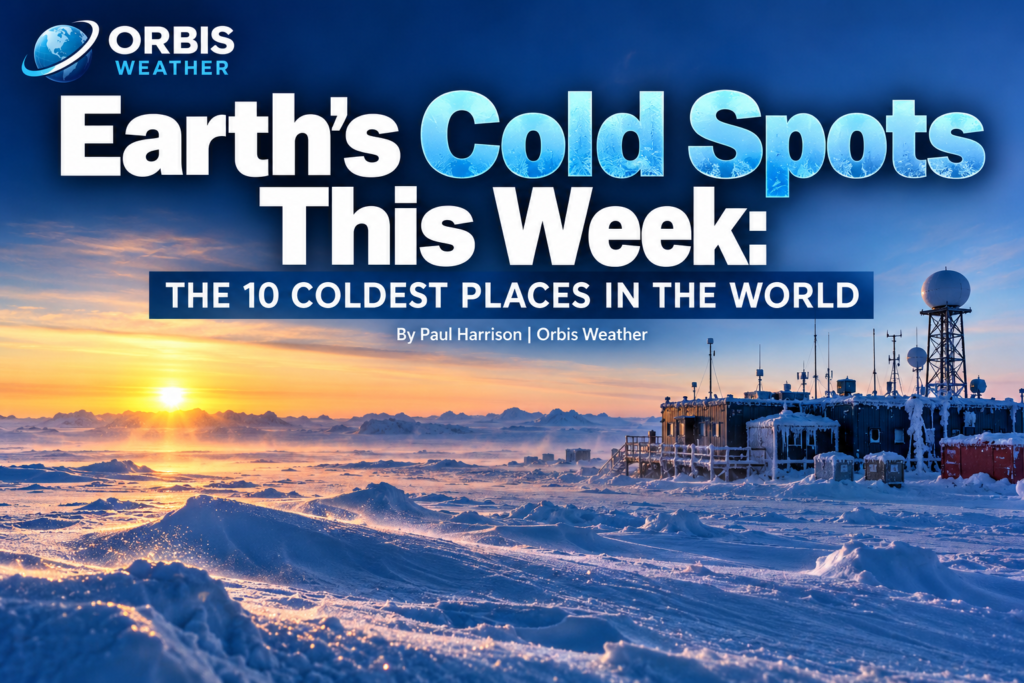
Earth’s Cold Spots This Week: The 10 Coldest Places in the World

- Europe Weather & Natural Hazards Today – Thursday, November 19, 2026 7:20 PM
- Southeast Asia Weather & Natural Hazards Today: Thursday, November 19, 2026 7:14 PM
- Singapore Monsoon & Flood This Week: Thursday, November 19, 2026 7:06 PM
- Africa Weather & Natural Hazards Today — Thursday, November 19, 2026 5:01 PM
- Middle East Weather & Natural Hazards Today – Thursday, November 19, 2026 4:12 PM
- Earth’s Cold Spots This Week Nov 18, 2026 3:00 PM
- Australia, New Zealand & Oceania Weather & Natural Hazards Today — Thursday, November 19, 2026 11:32 AM
- North America Weather & Natural Hazards Today — November 18, 2026 8:42 AM
- Central America Weather & Natural Hazards Today – Wednesday, November 18, 2026 8:34 AM
- South America Weather & Natural Hazards Today – Wednesday, November 18, 2026 8:26 AM
- Daily Earthquakes, Storms, Fires & Floods Report — November 18, 2026 8:18 AM
- Weekly Earth’s Extreme Weather Report — Wednesday, November 18, 2026 8:11 AM
- Australian Region Tropical Weather Update: Wednesday, November 18, 2026 7:58 AM
- Southwest Indian Ocean Tropical Weather Update: Wednesday, November 18, 2026 7:52 AM
- WESTERN PACIFIC Tropical Weather Update – November 18, 2026 7:42 AM





Earth’s Cold Spots This Week: The 10 Coldest Places in the World
By Paul Harrison, Orbis Weather
Week covered: Wednesday, November 11 to Tuesday, November 17, 2026.
The coldest reading on Earth this week was −66°F (−54.2°C) at Vostok, the Russian research station on the East Antarctic Plateau. Pogoda i Klimat’s synoptic archive shows the minimum reported at 00 UTC on Saturday, November 14.
Three of the ten coldest places were in Antarctica, all on the high plateau. The other seven were in Russia’s Far East: six in Yakutia and one in Magadan Oblast. Tuesday, November 17, was the coldest day for six of the ten. Oymyakon, in Yakutia, was the coldest place outside Antarctica.
The 10 coldest places
Each place is ranked by its lowest observed daily minimum from November 11 to 17, dated by the UTC day it was reported; ties share a rank.
Rank | Place | Elevation | Lowest temperature | Date | Station type |
|---|---|---|---|---|---|
1 | 11,444 ft (3,488 m) | −66°F (−54.2°C) | Sat Nov 14 | Russian Antarctic research station | |
2 | 10,663 ft (3,250 m) | −61°F (−51.9°C) | Fri Nov 13 | Automatic weather station | |
3 | 9,285 ft (2,830 m) | −57°F (−49.4°C) | Thu Nov 12 | US Antarctic research station | |
4 | 2,428 ft (740 m) | −49°F (−45.2°C) | Tue Nov 17 | Synoptic weather station | |
5 | 446 ft (136 m) | −42°F (−41.3°C) | Mon Nov 16 | Synoptic weather station | |
6 | 4,219 ft (1,286 m) | −40°F (−39.8°C) | Tue Nov 17 | Synoptic weather station | |
7 | 1,309 ft (399 m) | −39°F (−39.5°C) | Mon Nov 16 and Tue Nov 17 | Synoptic weather station | |
8 | 2,116 ft (645 m) | −39°F (−39.4°C) | Tue Nov 17 | Synoptic weather station | |
9 | 302 ft (92 m) | −38°F (−39.0°C) | Tue Nov 17 | Synoptic weather station | |
10 | 640 ft (195 m) | −36°F (−37.9°C) | Tue Nov 17 | Synoptic weather station |
Just outside the list, Yakutsk recorded −36°F (−37.8°C) at 21 UTC on Tuesday, and Olenek reached −35°F (−37.1°C) the same day.
Where the cold showed up
East Antarctic Plateau. The plateau’s lowest readings came early, between Thursday and Saturday, and then eased. Vostok’s daily minimum rose to −46°F (−43.5°C) by Monday. Dome C II’s minimum was −42°F (−40.9°C) the same day, and the South Pole reached −35°F (−37.3°C) on Sunday.
Coastal Antarctica. Coastal stations were far milder than the plateau. Neumayer (Germany) reached −1°F (−18.5°C) on Tuesday, and McMurdo (US) and Syowa (Japan) each touched 0°F (−17.9°C and −17.5°C) on Wednesday, November 11. Australia’s Casey, Mawson and Davis stations stayed between 5°F and 9°F (−15.0°C and −12.6°C).
Siberia and Yakutia. In Yakutia the cold deepened through the week. Oymyakon’s daily minimum fell from −34°F (−36.9°C) on Wednesday to its low on Tuesday. In the regional capital, Yakutsk, the minimum fell from 5°F (−14.8°C) to −33°F (−36.0°C) over the same days. On the Arctic coast, Khatanga reached −29°F (−34.1°C) on November 13 and Tiksi −27°F (−32.8°C) on Tuesday.
Greenland and the North American Arctic. The coldest readings here came from far northern Greenland and Canada’s High Arctic. Cape Morris Jesup, an automatic station, reached −27°F (−32.6°C) on Saturday, November 14. Eureka, Nunavut, recorded −25°F (−31.7°C) on Thursday, and Resolute −21°F (−29.3°C) on Monday. Alaska stayed mild: its lowest airport reading was −4°F (−20.0°C) at Northway on Thursday and Friday.
About this list
The ranking uses synoptic reports from national weather services, compiled by Pogoda i Klimat and Meteociel, with Iowa Environmental Mesonet airport data for Alaska and Canada. It covers November 11 to 17, 2026, by UTC date. Russian-network stations report a daily minimum at fixed hours, usually 00 or 21 UTC, so each value covers the hours before the report.
Several cold stations had no November data and could not be ranked. They include Concordia, Dome Fuji and Relay Station on the Antarctic Plateau, Delyankir and Agayakan in Yakutia, and Summit Station on the Greenland ice sheet. Pogoda i Klimat labels WMO station 89828 as Dome Fuji, but its coordinates match Dome C II in the University of Wisconsin station list. No reading in the top-ten range failed quality checks; one isolated Mongolian reading, at Tosontsengel, was excluded as suspect. All figures are preliminary and can be revised.
Frequently asked questions
Why are seven of the ten in Russia rather than Antarctica? Only three high-plateau stations had a full week of data in the public archives. The plateau also turned milder after Saturday, while minimums in Yakutia kept falling into Tuesday.
Why does Tompo show two dates? Tompo reported the same minimum at 21 UTC on both Monday and Tuesday, so both days are listed. Other sites can also date a reading one day earlier: Meteociel lists Vostok’s minimum on Friday, November 13, because the value reported at 00 UTC Saturday covers Friday night.
Was any of this week’s cold a record? None of the forecasts or statements issued during the week called these readings records. On November 14, Hydrometcentre forecaster Lyudmila Parshina told NEWS.ru that central Yakutia would be colder than normal, with nights of −33 to −40°C (−27 to −40°F).
What do forecasters expect next? For Thursday, November 19, the Yakutsk weather service forecast nights down to −46°C (−51°F) in Yakutia’s northeast and −37 to −39°C (−35 to −38°F) in Yakutsk, YSIA reported. In Alaska, the National Weather Service in Fairbanks wrote that “Much of the Interior has a chance to see their first below 0 (F) temperatures of the winter next week.”
Sources
All station pages were accessed on November 18, 2026.
- Pogoda i Klimat, synoptic archives for November 11–17, 2026: Vostok, WMO 89828 (Dome C II), Oymyakon, Verkhoyansk, Vostochnaya, Tompo, Susuman, Zhigansk, Ust-Moma, Yakutsk, Olenek
- Pogoda i Klimat, November 2026 daily tables: Vostok, South Pole, Neumayer, McMurdo, Syowa, Casey, Mawson, Davis, Oymyakon, Yakutsk, Khatanga, Tiksi, Tosontsengel, Cape Morris Jesup, Eureka, Resolute
- Meteociel, November 2026 monthly observations: Amundsen-Scott South Pole, Vostok
- University of Wisconsin–Madison AMRC, AWS station list (undated)
- Iowa Environmental Mesonet, Northway, Alaska daily minimums, November 11–17, 2026
- NEWS.ru, “От морозов -40 до аномального тепла: погода в России с 16 по 22 ноября”, November 14, 2026
- YSIA, “Морозы до −46° и туман в Якутске: прогноз погоды на 19 ноября”, November 18, 2026
- National Weather Service Fairbanks, Area Forecast Discussion, issued 4:30 a.m. AKST, November 18, 2026
About the Author
Paul Harrison — Founder & Publisher, Orbis Weather
Paul Harrison founded Orbis Weather in 2026 to make global weather and natural-hazard information easier to find, follow and understand. His coverage includes tropical cyclones, severe weather, extreme temperatures, earthquakes, volcanoes, wildfires, flooding and significant natural disasters worldwide.
View all articles by Paul Harrison → | Editorial Standards →
Global Weather Tracker Hub
Explore weather maps, tropical systems, storms and natural hazards around the world.
No matching trackers found.