
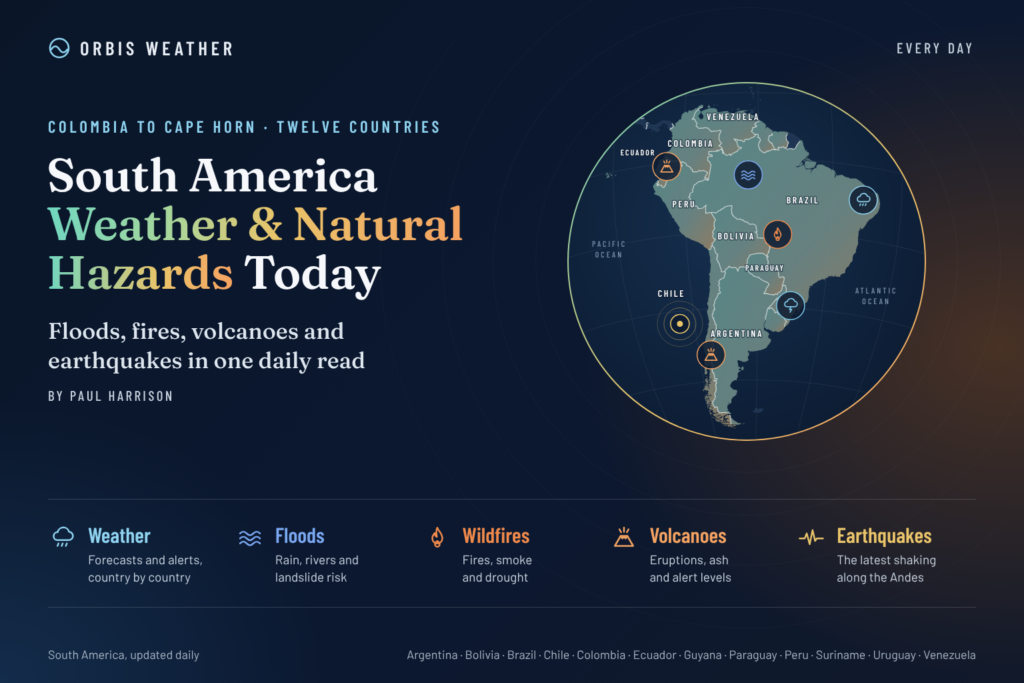
South America Weather & Natural Hazards Today

- Australia, New Zealand & Oceania Weather & Natural Hazards Today — Thursday, November 19, 2026 11:32 AM
- North America Weather & Natural Hazards Today — November 18, 2026 8:42 AM
- Central America Weather & Natural Hazards Today – Wednesday, November 18, 2026 8:34 AM
- South America Weather & Natural Hazards Today – Wednesday, November 18, 2026 8:26 AM
- Daily Earthquakes, Storms, Fires & Floods Report — November 18, 2026 8:18 AM
- Weekly Earth’s Extreme Weather Report — Wednesday, November 18, 2026 8:11 AM
- Australian Region Tropical Weather Update: Wednesday, November 18, 2026 7:58 AM
- Southwest Indian Ocean Tropical Weather Update: Wednesday, November 18, 2026 7:52 AM
- WESTERN PACIFIC Tropical Weather Update – November 18, 2026 7:42 AM





South America Weather & Natural Hazards Today – Wednesday, November 18, 2026
By Paul Harrison | Orbis Weather
Published: Wednesday, November 18, 2026 | South America Regional Weather & Natural Hazards Report
Heavy Rain Threatens Brazil, Colombia Faces Landslide Risks as South America Monitors Flooding, Severe Storms and El Niño
South America enters Wednesday, November 18, with heavy rainfall, thunderstorms, flooding concerns and landslide hazards among the continent’s most significant weather threats.
Brazil and Colombia are the principal areas of concern, with official meteorological forecasts identifying substantial rainfall potential across parts of Brazil and continued wet conditions affecting Colombia’s Pacific and Andean regions.
Across Brazil, a broad corridor of tropical moisture is helping maintain unsettled weather from the Amazon Basin into central and southeastern states. Some locations could receive substantial rainfall accumulations over the coming week, increasing the possibility of flash flooding, river rises and disruption to transportation.
Colombia is also experiencing an active rainfall period. Recent official assessments have identified landslide threats in mountainous municipalities, while forecasts for November 18 show further precipitation across western parts of the country.
Elsewhere, Peru, Ecuador and Bolivia face seasonal thunderstorm and mountain-weather hazards, while Argentina, Paraguay and Uruguay are monitoring changing spring weather patterns as the Southern Hemisphere approaches summer.
The developing 2026–27 El Niño event adds another important dimension, potentially influencing rainfall distribution, drought conditions and temperature patterns across South America over the coming months.
Today’s main natural hazard concerns: Heavy rain, thunderstorms, flash flooding, landslides, lightning, strong winds, river flooding, heat, wildfire vulnerability and seismic activity.
Reporting note: This article distinguishes officially documented forecasts from general seasonal hazards. Not every country has a newly verified national warning for November 18, and the absence of a confirmed warning here does not mean conditions are risk-free.
1. Brazil – Heavy Rain, Flooding and Severe Thunderstorms
Brazil remains one of South America’s most important weather-monitoring regions today.
The Brazilian National Institute of Meteorology (INMET) has identified a substantial rainfall pattern affecting central, northern and southeastern parts of the country during November 16–23.
An atmospheric trough and associated tropical moisture are supporting periods of widespread rain and thunderstorms, with some areas facing the potential for significant accumulated rainfall.
Central and northern Brazil
Areas requiring particular attention include Goiás, Tocantins, Bahia and parts of the Amazon Basin.
INMET’s weekly outlook identifies the following potential rainfall accumulations:
Region | Forecast rainfall, November 16–23 |
|---|---|
Central/northern Goiás and Tocantins | Up to 200 mm (7.9 inches), locally higher |
Western and southwestern Bahia | 150–200 mm (5.9–7.9 inches) in wetter areas |
Parts of Amazonas | 100–150 mm (3.9–5.9 inches), locally above 200 mm |
Western/northern Rio Grande do Sul and nearby Santa Catarina | 100–150 mm (3.9–5.9 inches) |
These figures represent potential accumulations over several days, not rainfall expected to fall entirely on Wednesday.
Persistent rainfall can saturate soils, increase runoff and contribute to rising river levels, particularly where drainage systems are already under pressure.
Southeastern Brazil
São Paulo, Minas Gerais, Rio de Janeiro and Espírito Santo remain important monitoring areas as tropical moisture interacts with changing atmospheric conditions.
Where thunderstorms become organized, potential hazards include intense downpours, lightning, gusty winds and isolated hail.
Large urban areas are particularly vulnerable to short-duration flooding when heavy rainfall overwhelms drainage networks.
Southern Brazil
Paraná, Santa Catarina and Rio Grande do Sul face changing weather as frontal systems move across southern South America.
INMET’s outlook also identifies the possibility of intense thunderstorms developing in southwestern Rio Grande do Sul late Wednesday, potentially affecting additional northern areas afterward.
Brazil outlook: Heavy rainfall remains a significant forecast concern, with central Brazil and portions of the south particularly important to monitor. Residents should consult INMET for current municipal warnings before traveling.
Source: Brazilian National Institute of Meteorology (INMET).
2. Colombia – Continued Rainfall and Landslide Concerns
Colombia remains one of the continent’s most closely watched countries for rainfall-related natural hazards.
The Institute of Hydrology, Meteorology and Environmental Studies (IDEAM) has published precipitation forecasts for November 18 showing continued rainfall across western Colombia, particularly along the Pacific coast and western Andean region.
Pacific and Andean regions
Official forecast maps indicate rainfall affecting sections of western Colombia during the early morning and morning hours.
The Pacific region remains particularly important because persistent rainfall, mountainous terrain and saturated soils can increase landslide vulnerability.
Departments requiring attention include Chocó, Cauca, Nariño and Antioquia.
Recent landslide alerts
IDEAM’s November 17 assessment identified high landslide threats in selected municipalities across eight departments:
Antioquia
Caldas
Cauca
Chocó
Nariño
Putumayo
Santander
Tolima
These classifications applied to individual municipalities rather than entire departments.
They provide important context for Wednesday’s continuing rainfall, although residents should check whether the classifications have been updated.
Why landslides are dangerous
Heavy rainfall can infiltrate steep slopes, reducing soil stability and increasing the possibility of sudden landslides.
Mountain roads, communities beneath steep hillsides and settlements near unstable riverbanks may be particularly vulnerable.
Warning signs include fresh cracks in the ground, unusual water seepage, falling rocks and sudden changes in stream flow.
Colombia outlook: Continued precipitation across western Colombia means landslide monitoring remains essential, especially in municipalities identified in recent official assessments.
Source: IDEAM Colombia.
3. Peru – New Heavy Rain Warning for November 18–20
Peru faces a renewed period of potentially hazardous rainfall, with an official warning covering Wednesday, November 18, through Friday, November 20.
The National Institute of Civil Defense (INDECI), using information from SENAMHI, has issued Bulletin No. 472-2026, extending an earlier precipitation advisory.
The bulletin forecasts moderate to heavy rainfall across parts of the northern coast and Andean highlands, accompanied by thunderstorms and gusty winds.
Forecast rainfall amounts
Region | Forecast daily rainfall |
|---|---|
Northern coast | 5–65 mm (0.2–2.6 inches) |
Northern highlands | 5–45 mm (0.2–1.8 inches) |
Central highlands | 5–25 mm (0.2–1.0 inches) |
Southern highlands | Around 35 mm (1.4 inches) |
Northern Peru
Tumbes and inland sections of Piura are among the principal areas highlighted for potentially heavy rainfall.
Localized flooding could affect roads, low-lying neighborhoods and communities near rivers or seasonal drainage channels.
Andean highlands
The warning also identifies several additional hazards:
Thunderstorms accompanied by lightning.
Wind gusts approaching 45 km/h (28 mph).
Hail above approximately 2,800 meters (9,186 feet).
Snowfall above approximately 3,800 meters (12,467 feet) in the central and southern highlands.
Mountain roads and high-altitude communities could experience difficult travel conditions.
Peru outlook: The November 18–20 warning is one of today’s clearest officially documented weather threats in South America. Residents in affected regions should prepare for heavy rain, thunderstorms, hail and possible flooding.
Source: Peru National Institute of Civil Defense (INDECI).
4. Ecuador – Flooding and Mountain Landslide Risks
Ecuador remains vulnerable to localized heavy rainfall and thunderstorms, particularly across coastal communities, the Amazon region and mountainous terrain.
Coastal Ecuador
Guayas, Los Ríos, Manabí and surrounding provinces should continue monitoring rainfall forecasts.
Where intense thunderstorms develop, potential hazards include temporary urban flooding, overflowing drainage channels and lightning.
Ecuadorian Andes
Mountain communities face additional challenges when prolonged rainfall saturates steep slopes.
Landslides can block highways, isolate settlements and disrupt transportation through mountainous regions.
Amazon region
Tropical showers and thunderstorms remain a seasonal concern across eastern Ecuador.
River levels can respond quickly to intense rainfall in smaller catchments.
Ecuador outlook: Flooding and landslide vulnerability remain important monitoring priorities. A new nationwide emergency for November 18 has not been independently confirmed in the information reviewed.
Official source: INAMHI Ecuador.
5. Argentina – Spring Thunderstorms and Changing Weather
Argentina is approaching the Southern Hemisphere summer, bringing increasing temperatures and the potential for thunderstorms across northern and central provinces.
Northern Argentina
Chaco, Formosa, Corrientes and Misiones are regions where warm, humid air can support thunderstorm development.
Potential hazards include heavy rainfall, lightning and localized flooding.
Communities near the Paraná and Paraguay river systems should monitor official river information when prolonged rainfall affects their catchments.
Central Argentina
Buenos Aires Province, Córdoba and Santa Fe can experience rapidly changing conditions as frontal systems interact with warmer air.
Severe thunderstorms may produce gusty winds, hail and intense rainfall, although no specific new nationwide severe-weather warning for November 18 has been verified for this report.
Patagonia
Southern Argentina remains exposed to strong winds, variable temperatures and rapidly changing mountain weather.
Travelers should monitor local conditions, particularly along exposed highways and in mountainous national parks.
Argentina outlook: Changing frontal weather and thunderstorm potential remain the main seasonal concerns. Specific warning areas should be checked with Argentina’s national meteorological service.
Official source: Servicio Meteorológico Nacional Argentina.
6. Chile – Wildfire Awareness, Mountain Weather and Strong Winds
Chile’s unusually varied geography creates different weather hazards across the country.
Northern Chile
The Atacama Desert remains predominantly dry, although mountain weather can change quickly at high elevations.
Strong winds and temperature fluctuations can create difficult conditions for travelers crossing the Andes.
Central Chile
As summer approaches, warmer temperatures and drying vegetation can increase wildfire vulnerability.
Areas surrounding Santiago, Valparaíso and central agricultural valleys should monitor fire-danger information, particularly during hot, windy periods.
Dry vegetation alone does not establish that a wildfire is occurring.
Southern Chile
Southern Chile and Patagonia can experience strong winds, rainfall and rapidly changing mountain conditions.
Outdoor recreation, marine travel and remote highway journeys require particular attention to local forecasts.
Chile outlook: Wildfire preparedness, wind and mountain weather remain important seasonal concerns. No specific major new wildfire outbreak for November 18 has been independently established in this report.
Official sources: Dirección Meteorológica de Chile and SENAPRED Chile.
7. Bolivia – Thunderstorms and Landslide Vulnerability
Bolivia’s weather conditions vary considerably between the tropical lowlands and the high-altitude Andes.
Eastern Bolivia
Santa Cruz, Beni and Pando can experience periods of tropical rainfall and thunderstorms.
Heavy local downpours may lead to temporary flooding in vulnerable communities.
Western Bolivia
La Paz, Cochabamba and surrounding mountain areas require attention to changing weather and slope stability.
Heavy rainfall can increase the risk of landslides, especially along steep mountain roads.
High-altitude locations may also experience sharp temperature changes.
Bolivia outlook: Thunderstorms, localized flooding and mountain landslide vulnerability remain seasonal concerns. A new countrywide emergency warning for Wednesday has not been verified.
Official source: SENAMHI Bolivia.
8. Paraguay and Uruguay – Thunderstorms and River Conditions
Paraguay
Paraguay remains vulnerable to heavy thunderstorms and changing river levels.
The Paraguay and Paraná river systems are particularly important because prolonged rainfall across neighboring countries can influence downstream conditions.
As temperatures rise toward summer, thunderstorms may produce intense rainfall, lightning and strong winds.
No new nationwide flooding emergency for November 18 has been independently confirmed in this report.
Uruguay
Uruguay is entering a warmer period of the year, with frontal systems capable of producing showers, thunderstorms and gusty winds.
Montevideo and coastal communities should monitor marine forecasts when strong winds are expected.
Agricultural regions may also be affected by heavy rainfall or hail during severe thunderstorms.
Paraguay and Uruguay outlook: Thunderstorm development and river conditions remain important monitoring priorities, but the latest local warnings should be checked before interpreting these as active alerts.
Official sources: Paraguay Meteorological Service and INUMET Uruguay.
9. Venezuela, Guyana, Suriname and French Guiana
Northern South America remains influenced by tropical moisture and seasonal rainfall patterns.
Venezuela
Warm and humid conditions can support scattered showers and thunderstorms, especially across interior and mountainous areas.
Localized flooding and landslides are possible where persistent rainfall affects vulnerable terrain.
Guyana and Suriname
Coastal communities and tropical interior regions should monitor rainfall forecasts.
Heavy thunderstorms can produce lightning, temporary street flooding and rapidly rising smaller waterways.
French Guiana
Tropical rainfall remains a regular feature of the regional climate.
Localized thunderstorms and intense rainfall can disrupt outdoor activities and transportation.
Northern South America outlook: Tropical showers and localized flooding remain potential hazards. No new region-wide disaster emergency for November 18 has been independently verified.
10. Earthquakes and Volcanoes – South America’s Pacific Ring of Fire
South America’s western margin is part of the Pacific Ring of Fire, one of the world’s most active regions for earthquakes and volcanic activity.
Earthquake monitoring
Chile, Peru, Ecuador and Colombia are particularly exposed to seismic hazards associated with tectonic plate boundaries.
Earthquakes can occur without warning, and their effects depend on magnitude, depth, distance from populated areas and local geological conditions.
For verified earthquake information, consult the USGS Real-Time Earthquake Map.
No specific major earthquake occurring on November 18 is being reported here without independently verified event information.
Volcanic activity
Several volcanic systems across the Andes remain under scientific observation.
Important monitoring agencies include:
Colombia’s Servicio Geológico Colombiano.
Ecuador’s Instituto Geofísico.
Peru’s Instituto Geofísico del Perú.
Chile’s SERNAGEOMIN.
Potential volcanic hazards include ashfall, volcanic gases, lahars and aviation disruption.
A new major eruption is not being claimed in this report without an official event bulletin.
11. El Niño 2026–27 – A Major Climate Factor for South America
The developing El Niño event remains one of the most important longer-term climate considerations for South America.
El Niño occurs when sea surface temperatures in the central and eastern equatorial Pacific become unusually warm, influencing atmospheric circulation and rainfall patterns across the world.
The 2026 event began earlier this year, with climate forecasts indicating the possibility of unusually strong conditions extending into 2027.
Potential impacts across South America
Northern South America: Parts of Colombia, Venezuela and northern Brazil may face increased drought and wildfire vulnerability as rainfall patterns shift.
Southern South America: Southern Brazil, northern Argentina and portions of Chile can experience changes in rainfall patterns, sometimes increasing the risk of flooding.
Pacific coast: Warmer ocean conditions can influence rainfall, marine ecosystems and fisheries, particularly around Ecuador and Peru.
These are broad climate tendencies, not predictions that every listed area will experience flooding or drought.
Individual weather events cannot automatically be attributed to El Niño without scientific analysis.
12. South America Natural Hazards Summary – November 18, 2026
Country | Main concern | Information status |
|---|---|---|
Brazil | Heavy rain, severe storms, flooding, hail and damaging winds | Official forecast |
Colombia | Rainfall and landslide threats | Official forecast and recent alerts |
Peru | Heavy rain, hail, lightning and mountain snow | Official warning, November 18–20 |
Ecuador | Flooding and landslide vulnerability | Seasonal monitoring |
Argentina | Thunderstorms and frontal weather | Seasonal monitoring |
Chile | Wildfire susceptibility, wind and mountain weather | Seasonal monitoring |
Bolivia | Thunderstorms and landslides | Seasonal monitoring |
Paraguay | Thunderstorms and river conditions | Seasonal monitoring |
Uruguay | Changing frontal weather | Seasonal monitoring |
Venezuela and Guianas | Tropical showers and localized flooding | Seasonal monitoring |
Information status describes the evidence available for this report and is not an official emergency severity rating.
13. South America Weather Outlook – November 19–20
Thursday, November 19
Brazil’s unsettled rainfall pattern is expected to continue in several regions, with central and northern states remaining important monitoring areas.
Southern Brazil may also experience additional thunderstorms as frontal systems influence the region.
Peru’s November 18–20 precipitation warning remains in effect, with heavy rainfall possible across parts of the northern coast and Andes.
Colombia’s western and mountainous regions will require continued attention to rainfall accumulation and slope stability.
Friday, November 20
Brazil’s INMET weekly forecast identifies another weather system capable of reinforcing storm activity across southern Brazil.
The agency warns that the broader pattern may support intense thunderstorms, including supercells or organized squall lines. Hail, damaging downbursts and even isolated tornadoes are possible in the forecast scenario.
This is a forecast risk, not confirmation that a tornado will occur.
Peru’s official precipitation advisory also extends through Friday, with thunderstorms, hail and mountain snow remaining possible in affected areas.
The combination of heavy rainfall, unstable atmospheric conditions and mountainous terrain makes continued monitoring particularly important.
14. Official Weather and Natural Hazard Sources
Orbis Weather recommends the following national and international agencies for the latest warnings and verified hazard information.
Region | Official source |
|---|---|
Brazil | |
Colombia | |
Peru | |
Ecuador | |
Argentina | |
Chile | |
Bolivia | |
Paraguay | |
Uruguay | |
Earthquakes | |
Global climate |
Final Outlook – South America, Wednesday, November 18, 2026
South America’s most significant documented weather concerns today center on heavy rainfall across Brazil, continuing landslide vulnerability in Colombia and a renewed official heavy-rain warning for Peru.
Brazil faces potentially substantial rainfall accumulations through November 23, with some central and northern regions forecast to receive around 200 mm (7.9 inches) or more. Southern Brazil also faces the possibility of increasingly severe thunderstorms.
Colombia continues to monitor rainfall across its Pacific and Andean regions following recent official landslide alerts.
Peru’s November 18–20 warning identifies heavy rain, lightning, hail, gusty winds and high-altitude snowfall, with northern coastal communities and mountainous areas particularly important to watch.
Elsewhere, the approaching Southern Hemisphere summer brings changing thunderstorm, heat and wildfire conditions across the continent.
The developing El Niño event adds uncertainty to longer-term rainfall and temperature patterns, making reliable forecasts and official hazard monitoring increasingly important.
Orbis Weather will continue following significant storms, flooding, earthquakes, volcanic activity, wildfires and other natural hazards affecting South America.
Weather and hazard conditions can change rapidly. This report is intended for regional awareness and does not replace official meteorological warnings, emergency instructions or local evacuation orders.
About the Author
Paul Harrison — Founder & Publisher, Orbis Weather
Paul Harrison founded Orbis Weather in 2026 to make global weather and natural-hazard information easier to find, follow and understand. His coverage includes tropical cyclones, severe weather, extreme temperatures, earthquakes, volcanoes, wildfires, flooding and significant natural disasters worldwide.
View all articles by Paul Harrison → | Editorial Standards →
Global Weather Tracker Hub
Explore weather maps, tropical systems, storms and natural hazards around the world.
No matching trackers found.