
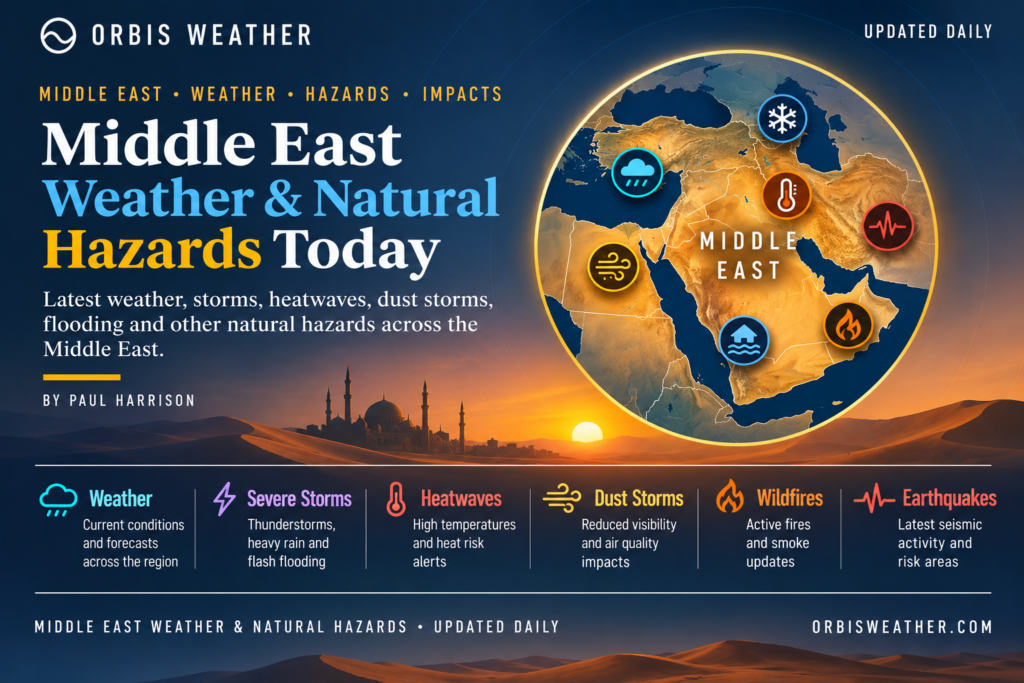
🌍 Middle East Weather & Natural Hazards Today

- Europe Weather & Natural Hazards Today – Thursday, November 19, 2026 7:20 PM
- Southeast Asia Weather & Natural Hazards Today: Thursday, November 19, 2026 7:14 PM
- Singapore Monsoon & Flood This Week: Thursday, November 19, 2026 7:06 PM
- Africa Weather & Natural Hazards Today — Thursday, November 19, 2026 5:01 PM
- Middle East Weather & Natural Hazards Today – Thursday, November 19, 2026 4:12 PM
- Earth’s Cold Spots This Week Nov 18, 2026 3:00 PM
- Australia, New Zealand & Oceania Weather & Natural Hazards Today — Thursday, November 19, 2026 11:32 AM
- North America Weather & Natural Hazards Today — November 18, 2026 8:42 AM
- Central America Weather & Natural Hazards Today – Wednesday, November 18, 2026 8:34 AM
- South America Weather & Natural Hazards Today – Wednesday, November 18, 2026 8:26 AM
- Daily Earthquakes, Storms, Fires & Floods Report — November 18, 2026 8:18 AM
- Weekly Earth’s Extreme Weather Report — Wednesday, November 18, 2026 8:11 AM
- Australian Region Tropical Weather Update: Wednesday, November 18, 2026 7:58 AM
- Southwest Indian Ocean Tropical Weather Update: Wednesday, November 18, 2026 7:52 AM
- WESTERN PACIFIC Tropical Weather Update – November 18, 2026 7:42 AM





Middle East Weather & Natural Hazards Today – Thursday, November 19, 2026
Heavy Rain and Flash-Flood Threats Continue Across Saudi Arabia as New Storm Systems Target Syria, Lebanon and Iraq, With a Potential Late-November Cold Outbreak
By Paul Harrison | Orbis Weather | Thursday, November 19, 2026
Middle East Weather Overview
The Middle East enters Thursday, November 19, 2026, with several significant weather developments demanding attention, including continued rainfall across parts of Saudi Arabia, unsettled conditions in the eastern Mediterranean, and the prospect of increasingly active storm systems affecting Iraq, Syria, Lebanon and Jordan later this month.
Western and southwestern Saudi Arabia remain among the principal areas of concern following forecasts of thunderstorms, locally heavy rainfall and potentially dangerous flash flooding.
Meanwhile, meteorologists are monitoring a developing sequence of low-pressure systems expected to bring additional rain to the Levant and Iraq, potentially accompanied by a substantial drop in temperatures during the final week of November.
The regional weather service WASM, in its November 18 bulletin, identified recurring rainfall across northwestern Syria and Lebanon, further precipitation across Saudi Arabia, and the possibility of a notably colder weather pattern toward the end of the month.
These developments are particularly important for communities vulnerable to flooding, displaced populations living in temporary accommodation, and travelers using mountain roads or desert valleys.
This report covers the weather outlook for Thursday, November 19, based on information available November 18. Forecast risks are distinguished from confirmed incidents and official warnings.
1. Saudi Arabia – Thunderstorms, Heavy Rain and Flash-Flood Potential
Saudi Arabia remains one of the most important weather-monitoring areas in the Middle East.
Recent forecasts indicate continuing rainfall across western, southwestern, northern and central districts, with some locations experiencing thunderstorms capable of producing intense localized precipitation.
Areas of greatest concern
Makkah and Taif: Periods of heavy rain could produce rapid surface-water accumulation and dangerous runoff.
Jazan and Asir: Mountainous terrain increases the potential for flash flooding and hazardous road conditions.
Al-Baha: Thunderstorms may bring locally heavy rainfall, reduced visibility and runoff through valleys.
Hail and Al-Qassim: Scattered showers and thunderstorms remain possible.
Northern Riyadh Region: Localized rainfall may affect roads and exposed desert areas.
Thursday, November 19 outlook
Rainfall activity is expected to remain possible across several western and central districts, particularly where unstable atmospheric conditions persist.
The WASM forecast issued November 18 identified Tuesday through Thursday as a period of scattered rainfall affecting these regions, with the heaviest activity focused on Makkah and the southwestern highlands.
The greatest concern is not necessarily the total amount of rainfall across an entire province, but how quickly intense precipitation can accumulate within individual catchments.
Dry riverbeds and mountain valleys can become dangerous within minutes when thunderstorms develop upstream.
Natural hazard assessment: Elevated localized flash-flood potential in areas receiving heavy thunderstorms. This is a forecast-based assessment, not confirmation of an active nationwide flood emergency.
Residents should follow the Saudi National Center for Meteorology for the latest official alerts.
2. United Arab Emirates – Variable Cloud, Coastal Humidity and Localized Rainfall Monitoring
The United Arab Emirates continues through its seasonal transition toward more variable late-autumn weather.
Dubai, Abu Dhabi, Sharjah, Fujairah and Ras Al Khaimah may experience changing cloud cover, coastal humidity and fluctuations in wind direction.
Main weather considerations
Dubai and Sharjah: Changing visibility, coastal humidity and the possibility of isolated showers.
Abu Dhabi: Coastal wind conditions, marine visibility and temperatures remain important for road and offshore operations.
Fujairah and Ras Al Khaimah: Mountainous and eastern coastal districts warrant particular attention when clouds and showers develop.
Thursday outlook
The available information does not establish a widespread severe-weather warning for the UAE on November 19.
Recent forecasts have indicated variable cloud and occasional rainfall opportunities, but these should not be interpreted as confirmation of rain in every emirate on Thursday.
Motorists should remain alert to sudden visibility reductions from fog or mist, particularly during overnight and early-morning hours.
Official forecasts and marine warnings are available from the UAE National Centre of Meteorology.
3. Iraq – Scattered Rain Ahead of Potentially More Significant Storm Systems
Iraq faces an increasingly active late-November weather pattern.
Meteorologists are monitoring low-pressure systems that could bring substantial rainfall to parts of the country during the final week of November.
In the shorter term, scattered showers and considerable temperature differences between regions remain possible.
Areas to monitor
Baghdad: Heavy showers can produce temporary flooding where urban drainage is inadequate.
Mosul and Nineveh: Northern districts may experience unsettled conditions as regional weather systems develop.
Erbil and Sulaymaniyah: Mountainous terrain presents additional risks from heavy rain, reduced visibility and unstable slopes.
Basra: Low-lying roads and urban areas remain vulnerable to standing water during intense downpours.
Thursday outlook
Scattered rain is possible across parts of Iraq over the next couple of days, according to the November 18 regional forecast.
A more significant rainfall event is being monitored for the final week of November, although its precise timing, intensity and geographical distribution remain uncertain.
Recent flooding in Iraq demonstrates the importance of monitoring drainage systems, rivers and roads before further heavy rainfall develops.
Natural hazard assessment: Localized rainfall risk in the short term, with the possibility of a more widespread rainfall episode later in November.
4. Iran – Recent Deadly Flooding Highlights Continuing Weather Risks
Iran remains vulnerable to several natural hazards, including flash flooding, mountain storms, landslides and earthquakes.
Earlier this month, severe weather caused fatalities and significant disruption across several Iranian provinces.
On November 8, Iranian emergency officials reported four deaths, 11 injuries and disrupted access to approximately 190 villages following flooding and severe weather. Lightning strikes were responsible for two of the reported deaths in Khuzestan province.
These were earlier November incidents and should not be confused with new casualties on November 19.
Areas requiring continued monitoring
Khuzestan: Flash flooding and thunderstorms can threaten roads and low-lying settlements.
Bushehr: Coastal storms and heavy showers can disrupt transport and marine activities.
Kohgiluyeh and Boyer-Ahmad: Mountainous terrain increases the danger of runoff and landslides.
Tehran and the Alborz Mountains: Seasonal cooling and changing mountain conditions require attention.
Zagros Mountains: Heavy precipitation can create dangerous conditions along mountain roads.
Thursday outlook
No new nationwide severe-weather emergency specifically for November 19 has been independently verified.
Communities recovering from earlier flooding should continue monitoring local river conditions, damaged infrastructure and updated meteorological warnings.
Earthquake monitoring
Iran lies within an active tectonic region where earthquakes represent a persistent natural hazard.
Earthquakes cannot be predicted using ordinary weather forecasts.
No specific major earthquake for November 19 is confirmed in the information reviewed for this report.
Readers can consult the US Geological Survey for real-time seismic observations.
5. Syria – Rainfall Across Northwestern Districts and Growing Cold-Weather Concerns
Northwestern Syria is expected to remain exposed to unsettled conditions as successive low-pressure systems affect the eastern Mediterranean.
Rainfall is forecast to focus on northwestern districts and coastal areas, with additional weather systems expected later in November.
Areas of concern
Latakia and Tartus: Coastal rainfall may become locally heavy, increasing the risk of surface flooding.
Idlib: Rain and colder conditions could worsen living conditions for vulnerable communities.
Aleppo: Changing temperatures and intermittent rainfall may affect transport and exposed populations.
Mountain communities: Reduced visibility, wet roads and falling temperatures may create difficult travel conditions.
Thursday outlook
Rainfall remains possible across northwestern Syria, with the potential for additional unsettled weather as the month progresses.
The November 18 regional forecast also highlighted the possibility of a sharp cold outbreak during the final days of November and early December.
The strength and exact timing of this potential cold outbreak remain uncertain.
Humanitarian concerns
Rain and falling temperatures can be especially dangerous for displaced families living in tents or damaged buildings.
Waterlogged ground, inadequate drainage and limited heating increase the consequences of even moderate winter storms.
The immediate priority is maintaining safe shelter, drainage and access to essential services.
6. Lebanon – Light Rain Thursday Before a Stronger Weekend Storm
Lebanon faces an increasingly unsettled weather pattern, with more significant rainfall expected later this week.
The Lebanese Meteorological Service’s November 18 bulletin provides a clearer distinction between Thursday’s relatively mild weather and the stronger system forecast for Sunday.
Thursday forecast
Partly cloudy conditions are expected, with temperatures rising above seasonal averages. Clouds should increase during the afternoon, accompanied by fog over higher elevations, scattered light rainfall and active winds.
Weekend outlook
Beginning Sunday, November 22, a low-pressure system accompanied by colder air is forecast to bring:
Heavy rainfall and thunderstorms.
Stronger winds.
A noticeable drop in temperatures.
Potentially hazardous conditions on exposed roads and in mountainous areas.
These developments are supported by Lebanon’s official meteorological bulletin.
Areas to monitor
Beirut: Rainfall intensity and urban drainage during the approaching weekend system.
Tripoli and northern Lebanon: Showers, coastal winds and localized surface flooding.
Bekaa Valley: Falling temperatures and reduced visibility.
Mount Lebanon: Fog, slippery roads and worsening conditions during the stronger storm.
Natural hazard assessment: Thursday’s main concerns are localized showers, wind and mountain fog. More significant rainfall and thunderstorm hazards are forecast from Sunday.
7. Israel and Palestine – Cooler Conditions and Increasing Rainfall Potential
The eastern Mediterranean is entering a period of more changeable weather.
Regional forecasts suggest falling temperatures and an increasing possibility of rainfall during the coming days, particularly along coastal districts.
Israel
Areas requiring routine monitoring include Tel Aviv, Haifa, Jerusalem and the Negev.
Heavy rainfall, when it occurs, can create localized flooding in urban districts and rapid runoff through desert drainage channels.
However, no widespread severe-weather emergency specifically for Thursday has been independently established.
Gaza and the West Bank
For displaced communities in Gaza, the approach of winter presents substantial humanitarian challenges.
Earlier November reporting described flooding affecting displaced people’s tents following heavy rainfall.
Additional rainfall could worsen shelter conditions, particularly in low-lying locations with inadequate drainage.
Thursday outlook
Scattered showers are possible in the wider eastern Mediterranean weather pattern, with regional forecasts pointing toward more substantial rainfall later in November.
The exact location and intensity of Thursday’s rainfall remain uncertain.
Natural hazard assessment: Seasonal flooding vulnerability and cold-weather exposure, particularly for displaced populations. This does not establish a new region-wide flood alert.
8. Jordan – Unsettled Weather and Potential Late-November Cold Outbreak
Jordan faces changing weather conditions as low-pressure systems develop over the eastern Mediterranean.
Areas to monitor
Amman: Increasing cloud cover and the possibility of showers as weather systems approach.
Irbid and northern Jordan: Greater exposure to incoming Mediterranean rainfall.
Petra: Flash flooding can become dangerous in narrow valleys when storms develop over upstream catchments.
Wadi Rum: Desert travelers should monitor rainfall across surrounding highlands.
Dead Sea region: Steep valleys and drainage channels can carry floodwater rapidly.
Thursday outlook
Variable cloud cover and fluctuating temperatures are expected during the coming days.
Rainfall opportunities are forecast to increase next week, particularly in northern Jordan.
Regional meteorologists are also monitoring a possible sharp cold outbreak toward the end of November and the beginning of December.
This longer-range outlook should be treated as provisional until supported by updated official forecasts.
9. Oman – Mountain Flooding, Coastal Weather and Marine Conditions
Oman’s combination of rugged mountains, coastal communities and desert valleys makes localized severe weather particularly important.
Main areas to monitor
Muscat: Coastal winds, humidity and visibility.
Sohar: Marine conditions and any developing cloud bands.
Nizwa and the Hajar Mountains: Mountain roads and normally dry wadis remain vulnerable during thunderstorms.
Salalah and Dhofar: Coastal conditions and changes in local wind patterns.
Thursday outlook
No new widespread severe-weather emergency has been independently verified for Oman on November 19.
Conditions should be monitored through Oman Meteorology, particularly for any development of thunderstorms over mountainous areas.
Even when rain is not falling at a particular location, floodwater can arrive from storms occurring many kilometers upstream.
10. Qatar, Bahrain and Kuwait – Gulf Weather and Changing Visibility
Across the central and northern Gulf, changing winds, humidity and localized rainfall remain relevant seasonal concerns.
Qatar
Doha and surrounding coastal districts should monitor humidity, visibility and changing marine conditions.
No significant nationwide storm emergency for Thursday has been independently established.
Bahrain
Coastal wind conditions, marine visibility and occasional cloud development remain the principal routine weather considerations.
Any significant rainfall would require updated confirmation from Bahrain’s meteorological authorities.
Kuwait
Kuwait is included in the broader regional outlook for possible rainfall activity.
Meteorologists are also monitoring a potentially more substantial rainfall episode during the final week of November, affecting Kuwait and neighboring areas.
This longer-range development remains subject to changes in timing and intensity.
11. Yemen – Flooding, Landslides and Vulnerable Infrastructure
Yemen remains highly vulnerable to natural disasters because of its mountainous terrain, exposed settlements and infrastructure challenges.
Areas of concern
Sana’a: Mountain weather, seasonal temperature changes and localized runoff.
Taiz: Steep roads and unstable slopes can become hazardous during heavy rainfall.
Aden: Coastal drainage and transport infrastructure remain vulnerable to intense showers.
Western highlands: Remote communities can become isolated when flooding damages roads or bridges.
Thursday outlook
No new nationwide flooding emergency for November 19 has been independently confirmed.
The primary concern remains the potentially severe consequences of localized storms in communities with limited access to emergency assistance.
12. Middle East Natural Hazards Summary – November 19, 2026
Country or region | Main hazard | Current assessment |
|---|---|---|
Saudi Arabia | Heavy thunderstorms, hail, flash flooding | Official Thursday alerts |
UAE | Visibility, coastal winds, isolated showers | Routine monitoring |
Iraq | Scattered rain, potential later storms | Rainfall forecast |
Iran | Flood recovery, mountain hazards | Continuing vulnerability |
Syria | Rain and approaching colder weather | Unsettled outlook |
Lebanon | Light rain, fog, stronger Sunday storm | Official forecast |
Israel and Palestine | Seasonal rain, flooding vulnerability | Monitoring |
Jordan | Changing weather, later cold outbreak | Developing outlook |
Oman | Wadi flooding, mountain weather | Conditional risk |
Qatar | Visibility and marine conditions | Routine monitoring |
Bahrain | Coastal winds and marine conditions | Routine monitoring |
Kuwait | Rainfall potential, later storms | Developing outlook |
Yemen | Flash flooding and landslides | Continuing vulnerability |
The assessments above combine official forecasts, regional meteorological outlooks and established natural-hazard vulnerabilities. They do not imply that every country has an active severe-weather warning.
13. Regional Outlook – Next 24 to 72 Hours
Arabian Peninsula
Saudi Arabia remains the principal immediate severe-weather concern, particularly in western and southwestern districts.
Its National Center for Meteorology reported on November 18 that moderate to heavy thunderstorms could produce flash flooding, hail and strong winds in Jazan, Asir, Al-Baha and Makkah, with lighter to moderate rain possible in other regions.
Eastern Mediterranean
Lebanon and northwestern Syria remain exposed to unsettled weather.
Lebanon’s more significant storm system is expected from Sunday, while broader regional forecasts indicate additional low-pressure systems later in November.
Iraq and Iran
Scattered rainfall remains possible in Iraq, with a potentially more significant system being monitored for the final week of the month.
In Iran, flood recovery and mountain weather remain important concerns following earlier November severe weather.
Gulf coastal waters
Marine operators should monitor updated wind, wave and visibility forecasts.
Thunderstorms can produce rapid changes in sea conditions, particularly around the Red Sea and exposed coastal waters.
14. Saudi Arabia – Official Weather Alerts for Thursday, November 19
Saudi Arabia’s National Center for Meteorology has published specific alerts covering Thursday, November 19, providing stronger evidence of the immediate severe-weather threat.
Among the alerts issued on November 18 are:
Location | Forecast hazard | Thursday alert period |
|---|---|---|
Makkah | Heavy rain, hail, thunderstorms | Noon–8 PM |
Al Taif | Heavy rain, strong winds, flooding | Noon–8 PM |
Al Jumum | Heavy rain, reduced visibility | Noon–8 PM |
Al Kamil | Heavy rain, thunderstorms | Noon–8 PM |
Bahrah | Moderate rain, hail, thunder | Noon–8 PM |
Al Qunfudhah | Moderate rain, rising waves | 6 AM–2 PM |
Parts of Hail | Light rain, thunderstorms | 1 PM–11 PM |
All times are local Saudi Arabian time. These are forecast alert periods published November 18, not confirmation that the events have occurred.
The alerts identify potential flash flooding, hail, lightning and significantly reduced visibility in affected areas.
This makes western Saudi Arabia the clearest officially documented immediate severe-weather concern in today’s Middle East report.
15. Weather Safety and Emergency Preparedness
Residents and travelers across the Middle East should take practical precautions during periods of unsettled weather.
Flash flooding: Never drive through flooded roads or enter wadis when thunderstorms are occurring upstream.
Thunderstorms: Seek substantial shelter during lightning and avoid exposed high ground.
Mountain travel: Check visibility, rainfall and road conditions before traveling through elevated terrain.
Marine conditions: Monitor official coastal forecasts before operating small vessels.
Cold-weather preparedness: Ensure vulnerable people have adequate shelter, dry clothing and heating before temperatures fall.
Earthquakes: Follow recognized earthquake safety guidance and distinguish confirmed seismic events from unsupported predictions.
16. Official Weather Sources and Monitoring
Orbis Weather recommends consulting national meteorological authorities and established scientific agencies for current warnings.
Agency | Coverage | Official website |
|---|---|---|
Saudi National Center for Meteorology | Saudi Arabia | |
UAE National Centre of Meteorology | United Arab Emirates | |
Oman Meteorology | Oman | |
Lebanese Meteorological Service | Lebanon | |
US Geological Survey | Global earthquakes | |
World Meteorological Organization | International meteorology | |
ReliefWeb | Humanitarian disasters |
Sources reviewed for this report
The principal reporting sources include the Saudi National Center for Meteorology’s November 18 daily forecast and November 19 weather alerts, the Lebanese Meteorological Service’s November 18 forecast, WASM’s November 18 regional outlook, and earlier November reporting on flooding in Iran and Gaza.
Forecasts and alerts can change after publication. Readers should consult the relevant official agency for the latest information.
17. Orbis Weather Final Outlook – Thursday, November 19, 2026
The Middle East enters Thursday with a clear distinction between immediate severe-weather threats and potentially more significant weather developments later this month.
Saudi Arabia faces the most clearly documented immediate threat, with official alerts identifying heavy thunderstorms, hail, reduced visibility and flash-flood potential across parts of the Makkah region and surrounding districts.
Lebanon is expecting relatively mild but increasingly unsettled conditions Thursday, ahead of a stronger storm system forecast to arrive Sunday.
Northwestern Syria remains exposed to recurring rainfall, while Iraq and Kuwait are among the countries being monitored for more substantial precipitation during the final week of November.
Across Jordan, Palestine and the wider eastern Mediterranean, meteorologists are monitoring the possibility of a sharp late-November temperature decline.
The greatest immediate safety priority is avoiding flash-flood-prone locations during thunderstorms, while communities across the northern Middle East should prepare for potentially wetter and colder conditions as December approaches.
The key message for November 19: Heavy rainfall and flash flooding remain the leading immediate weather threats in western Saudi Arabia, while a potentially more active and colder weather pattern is developing across the Levant and Iraq.
About Orbis Weather
Orbis Weather provides independent international weather reporting, regional forecasts and natural-hazard analysis, helping readers understand developing weather patterns and their potential consequences.
This report was prepared by Paul Harrison using available meteorological bulletins, official warnings, established scientific information and recent regional reporting.
Editorial Methodology
Orbis Weather distinguishes between confirmed weather events, official meteorological warnings, forecast developments and general natural-hazard vulnerabilities.
Where current information cannot be independently verified, the report avoids presenting an event or warning as confirmed.
Forecasts may change as updated observations and meteorological models become available.
Corrections and Updates Policy
Orbis Weather is committed to accuracy, transparency and responsible weather reporting.
Significant factual errors will be corrected when identified, and developing weather stories may be updated as reliable new information becomes available.
Readers can consult the official sources listed above to independently verify weather alerts and scientific information.
Important Disclaimer
This article is intended for general public information and does not replace official meteorological warnings, evacuation instructions or emergency guidance.
Weather and natural-hazard conditions can change rapidly. Residents and travelers should follow instructions from national meteorological agencies, civil defense authorities and local emergency services.
Published for Orbis Weather | Thursday, November 19, 2026
By Paul Harrison
About the Author
Paul Harrison — Founder & Publisher, Orbis Weather
Paul Harrison founded Orbis Weather in 2026 to make global weather and natural-hazard information easier to find, follow and understand. His coverage includes tropical cyclones, severe weather, extreme temperatures, earthquakes, volcanoes, wildfires, flooding and significant natural disasters worldwide.
View all articles by Paul Harrison → | Editorial Standards →
Global Weather Tracker Hub
Explore weather maps, tropical systems, storms and natural hazards around the world.
No matching trackers found.