
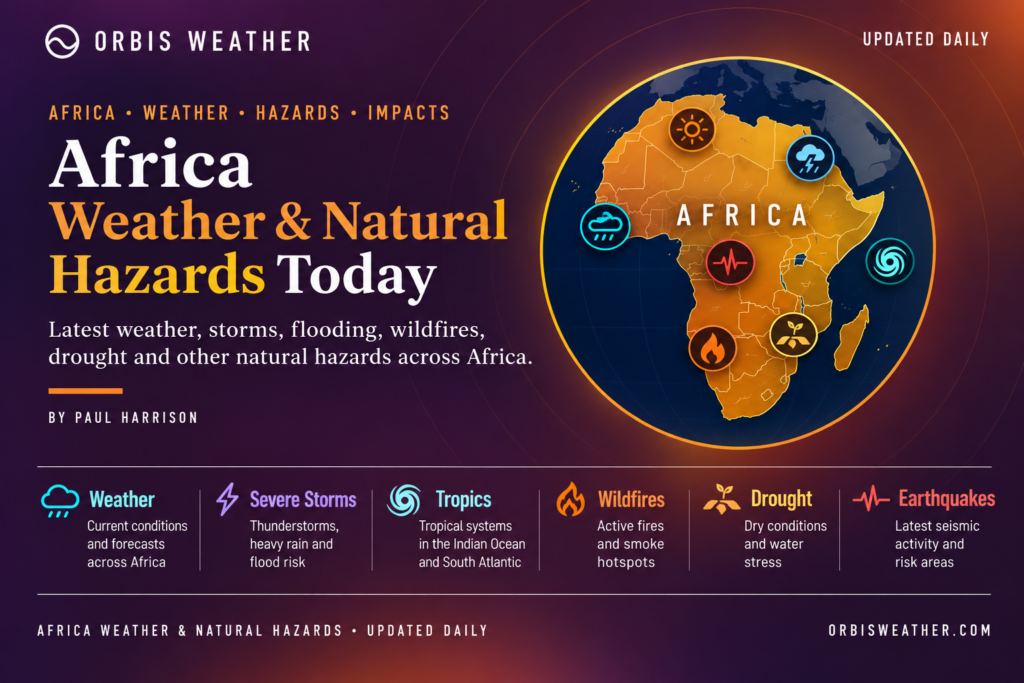
🌍 Africa Weather & Natural Hazards Today

- Europe Weather & Natural Hazards Today – Monday, November 16, 2026 7:14 PM
- Southeast Asia Weather & Natural Hazards Today: Monday, November 16, 2026 7:07 PM
- Singapore Weather & Natural Hazards This Week, November 16, 2026 6:58 PM
- Africa Weather & Natural Hazards Today — Monday, November 16, 2026 5:43 PM
- Middle East Weather & Natural Hazards Today – Monday, November 16, 2026 3:58 PM
- Global Volcano Report — November 8–14, 2026 3:22 PM
- Global Earthquake Report — November 8–14, 2026 (M4.5+) 3:12 PM
- Australia, New Zealand & Oceania Weather & Natural Hazards Today — Monday, November 16, 2026 12:15 PM
- Flooding in Aceh Spurs Warnings as Severe Weather Threatens 9:09 AM
- North America Weather & Natural Hazards Today – November 15, 2026 8:57 AM
- Central America Weather & Natural Hazards Today – Sunday, November 15, 2026 8:49 AM
- South America Weather & Natural Hazards Today – November 15, 2026 8:41 AM
- Weekly Earth Watch: Volcanoes, Earthquakes & Natural Hazards – Week ending November 15, 2026 8:29 AM
- Daily Earthquakes, Storms, Fires & Floods Report November 15, 2026 8:21 AM
- Australian Region Tropical Weather Update: Sunday, November 15, 2026 8:14 AM
- Southwest Indian Ocean Tropical Weather Update: Sunday, November 15, 2026 8:06 AM
- WESTERN PACIFIC Tropical Weather Update – November 15, 2026 7:57 AM





Africa Weather & Natural Hazards Today — Sunday, November 15, 2026
By Paul Harrison | Orbis Weather
Published: Sunday, November 15, 2026 (Africa local date)
Coverage: North Africa | West Africa | Central Africa | East Africa | Southern Africa | Madagascar | Southwest Indian Ocean
🌍 Africa Weather Overview: Flood Threats in East Africa, Severe Storms in South Africa and Growing El Niño Concerns
Africa enters Sunday, November 15, facing contrasting weather hazards, from potentially dangerous rainfall and flooding in East Africa to severe thunderstorms across parts of southern Africa and increasingly dry conditions across the Sahel.
The most significant immediate concerns are the continuing accumulation of heavy rainfall across Kenya, Tanzania, southern Ethiopia and southern Somalia, alongside the aftermath of severe thunderstorms forecast for South Africa’s KwaZulu-Natal province on Saturday.
The South African Weather Service issued a Level 5 warning for parts of KwaZulu-Natal on November 14, including communities around Howick, Ladysmith and Newcastle. That warning covered Saturday afternoon and evening and should not be treated as automatically remaining active on Sunday.
Meanwhile, a strengthening El Niño is adding uncertainty to rainfall patterns across the continent. The World Meteorological Organization has warned that the Southwest Indian Ocean region faces a combination of possible drought, excessive rainfall, unusual heat and tropical cyclone hazards during the 2026–2027 season.
This report covers the principal weather and natural-hazard risks for Sunday, November 15, and the days ahead. Regional risk assessments are distinguished from confirmed active warnings.
🚨 1. Africa’s Main Weather Hazards — November 15
Region | Main hazard | Outlook |
|---|---|---|
🇰🇪 Kenya | Heavy rainfall and flooding | High concern |
🇪🇹 Southern Ethiopia | Heavy rain and flash flooding | Elevated |
🇸🇴 Southern Somalia | River flooding | Elevated |
🇹🇿 Tanzania | Thunderstorms and heavy rain | Elevated |
🇷🇼 Rwanda / 🇧🇮 Burundi | Landslides and flooding | Elevated |
🇿🇦 Eastern South Africa | Severe thunderstorms | Monitor new warnings |
🇨🇩 DR Congo | Tropical rainfall and landslides | Localized risk |
🇿🇼 Zimbabwe / 🇿🇲 Zambia | Rainfall variability | Seasonal concern |
🇳🇬 Nigeria / Sahel | Heat, dust and dry conditions | Seasonal concern |
🇲🇬 Madagascar / Mozambique | Tropical cyclone preparedness | Seasonal monitoring |
These assessments describe meteorological risks, not a continent-wide collection of confirmed official alerts.
⛈️ 2. Southern Africa — Thunderstorms, Heavy Rain and Changing Seasonal Conditions
🇿🇦 South Africa: KwaZulu-Natal remains a priority
KwaZulu-Natal enters Sunday following a period of heightened severe-weather concern.
The November 14 Level 5 warning identified the potential for damaging thunderstorms, intense rainfall, lightning, hail and localized flooding.
The principal concerns for Sunday include waterlogged roads, runoff into low-lying communities, swollen streams and additional thunderstorms if unstable conditions persist.
Residents in KwaZulu-Natal, Mpumalanga and surrounding eastern provinces should monitor updated South African Weather Service advisories before travelling.
A new Level 5 warning for November 15 has not been independently verified for this report.
🇿🇼 Zimbabwe, 🇿🇲 Zambia and 🇲🇼 Malawi
The summer rainfall season is developing across much of south-central Africa.
Thunderstorms can provide important rainfall for agriculture, but intense downpours may also cause localized flash flooding, lightning injuries and disruption to rural transport.
Rainfall timing will be particularly important for farming communities as the growing season progresses.
🇧🇼 Botswana and 🇳🇦 Namibia
Heat, dry vegetation and variable early-season rainfall remain important concerns.
Periods of hot, dry weather can increase water demand and create favorable conditions for grassfires.
Farmers and communities should monitor local rainfall forecasts rather than assuming that widespread seasonal rains have become established.
🇲🇿 Mozambique
Mozambique faces two developing seasonal concerns: heavy summer rainfall and increasing tropical cyclone exposure.
The country’s long Indian Ocean coastline and major river systems make it vulnerable to flooding when prolonged rainfall or tropical systems affect the region.
No specific cyclone landfall in Mozambique is confirmed in this report.
🌧️ 3. East Africa — Heavy Rainfall and Flooding Remain Major Concerns
East Africa is among the continent’s most important regions to monitor.
Regional guidance for November 10–17 has highlighted above-normal rainfall potential across parts of Kenya, Tanzania, Ethiopia, Somalia, Uganda, Rwanda and Burundi.
The greatest risks are associated with persistent rainfall, saturated ground, rapidly rising rivers and flooding in densely populated urban areas.
🇰🇪 Kenya: Flood preparedness remains critical
Kenya faces significant concern over the possibility of widespread El Niño-related flooding.
Authorities have been preparing for heavy seasonal rainfall, with particular attention to drainage systems, vulnerable settlements and emergency response capacity.
The main hazards include:
Flash flooding in urban neighborhoods and informal settlements.
River flooding in low-lying agricultural districts.
Landslides in steep and mountainous terrain.
Damage to roads, bridges and essential infrastructure.
Contamination of drinking-water supplies after flooding.
Nairobi and other major urban areas are especially vulnerable where heavy rain overwhelms drainage networks.
The flood risk may continue after rainfall weakens because water from upstream catchments can take time to reach downstream communities.
🇪🇹 Ethiopia
Southern Ethiopia remains vulnerable to heavy seasonal rainfall and localized flooding.
Mountainous districts face additional landslide risks where persistent rainfall saturates slopes.
Rainfall conditions vary considerably across Ethiopia, and flood threats in southern districts should not be interpreted as uniform conditions nationwide.
🇸🇴 Somalia
Southern Somalia requires close monitoring of rainfall and river levels.
The Juba and Shabelle river systems are particularly important because flooding can develop following heavy rainfall in upstream catchments, including areas outside Somalia.
Flood-prone communities should follow local river advisories and evacuation instructions.
🇹🇿 Tanzania
Thunderstorms and substantial rainfall remain concerns across parts of Tanzania.
Potential impacts include urban flooding, lightning, poor road visibility and dangerous conditions for small vessels on inland lakes.
Communities around Lake Victoria should be particularly cautious during thunderstorms, when sudden strong winds can create hazardous boating conditions.
🇺🇬 Uganda, 🇷🇼 Rwanda and 🇧🇮 Burundi
The Great Lakes region remains vulnerable to intense thunderstorms.
Mountainous areas of Rwanda and Burundi face a combination of flash-flood and landslide exposure.
Heavy rainfall can rapidly affect steep valleys, hillside roads and settlements close to rivers.
🇸🇸 South Sudan and 🇸🇩 Sudan
Flood vulnerability, river conditions and heat exposure remain important humanitarian concerns.
High temperatures can increase dehydration and heat-related illness, especially in communities with limited access to clean water, electricity and healthcare.
🌧️ 4. Central Africa — Tropical Rainfall and Localized Flooding
🇨🇩 Democratic Republic of the Congo
The Congo Basin remains vulnerable to tropical thunderstorms, lightning and intense localized rainfall.
Kinshasa and other major urban areas can experience rapid surface-water flooding when drainage systems are overwhelmed.
Eastern DR Congo faces additional landslide exposure because of mountainous terrain and vulnerable infrastructure.
🇨🇲 Cameroon, 🇬🇦 Gabon and 🇨🇬 Republic of the Congo
Equatorial rainfall remains an important feature of the regional climate.
Localized thunderstorms can produce short periods of heavy rain, reduced visibility and disruption to road transport.
Rainfall distribution may be uneven, with some districts receiving substantial downpours while nearby locations remain comparatively dry.
🇨🇫 Central African Republic and 🇬🇶 Equatorial Guinea
Thunderstorms, river levels and local flooding remain hazards to monitor.
No new nationwide weather emergency has been independently confirmed for these countries for November 15.
☀️ 5. West Africa — Dry Season, Heat and Dust
🇳🇬 Nigeria
Northern Nigeria is progressing further into its dry season, with increasing attention on heat, dust and reduced visibility.
The Harmattan season can bring dry, dusty air from the Sahara into parts of West Africa, particularly as the season advances.
Southern Nigeria may continue to experience showers and isolated thunderstorms, although rainfall generally becomes less widespread during November.
🇬🇭 Ghana, 🇨🇮 Côte d’Ivoire and 🇱🇷 Liberia
Coastal and southern districts may experience occasional showers and thunderstorms.
Rainfall variability remains important for agriculture, particularly where crops depend on adequate soil moisture.
🇸🇳 Senegal, 🇲🇱 Mali, 🇳🇪 Niger and 🇹🇩 Chad
Dry conditions are becoming increasingly established across the Sahel.
The main seasonal hazards include airborne dust, reduced visibility, high daytime temperatures and vegetation-fire exposure.
People with respiratory conditions should take precautions during significant dust events.
🌦️ 6. North Africa — Mediterranean Rainfall and Desert Conditions
🇲🇦 Morocco
November brings increasing opportunities for Atlantic weather systems to affect Morocco.
Northern and western districts can experience rain, gusty winds and occasional thunderstorms.
Mountainous areas are particularly vulnerable to flash flooding during intense rainfall.
🇩🇿 Algeria and 🇹🇳 Tunisia
Mediterranean coastal districts may experience periods of unsettled weather as autumn progresses.
Farther inland, dry conditions dominate, with blowing dust possible during stronger wind events.
🇪🇬 Egypt and 🇱🇾 Libya
Generally dry weather remains typical across much of Egypt and Libya.
Occasional Mediterranean disturbances can bring rainfall to northern coastal areas, while desert regions remain exposed to dust and large differences between daytime and nighttime temperatures.
No widespread severe-weather emergency is confirmed for either country in this report.
🌀 7. Southwest Indian Ocean — Tropical Cyclone Season Approaches
Madagascar, Mozambique, Mauritius, Réunion and surrounding islands are entering a period of increasing tropical cyclone awareness.
The Southwest Indian Ocean cyclone season typically extends from November into April, with the most active period generally occurring during the Southern Hemisphere summer.
The World Meteorological Organization’s October regional outlook emphasized that the strengthening El Niño could influence tropical cyclone behavior, rainfall and temperatures across the region.
Importantly, El Niño does not produce identical weather outcomes everywhere. Some areas may experience rainfall deficits, while others face excessive rain or tropical cyclone impacts.
🇲🇬 Madagascar
Madagascar’s eastern coastline is particularly exposed to tropical systems approaching from the Indian Ocean.
Preparedness priorities include coastal flooding, damaging winds, landslides and disruption to roads and electricity supplies.
🇲🇺 Mauritius and 🇷🇪 Réunion
Marine conditions, heavy rainfall and tropical cyclone development are important monitoring priorities throughout the season.
Tropical cyclone status: No active named cyclone or new landfall threat has been independently verified for November 15 in this report. This is not confirmation that the basin is storm-free.
Official cyclone information is available from Météo-France Réunion.
🌋 8. Earthquakes and Volcanoes — Africa’s Geological Hazards
Weather is only one component of Africa’s natural-hazard picture.
East African Rift System
The East African Rift extends through several countries, including Ethiopia, Kenya, Uganda and Tanzania.
Earthquakes occur as tectonic forces gradually pull sections of the African continent apart.
Even moderate earthquakes can damage vulnerable buildings, particularly in communities with limited earthquake-resistant infrastructure.
Active volcanic regions
Volcanic monitoring remains important around:
Mount Nyiragongo and Nyamuragira in eastern DR Congo.
Erta Ale in Ethiopia’s Afar region.
Ol Doinyo Lengai in northern Tanzania.
Volcanic hazards can include lava flows, toxic gases, ash emissions and earthquakes.
Current status: No new major eruption, significant earthquake or associated evacuation order has been independently verified for November 15 in this report.
Readers can monitor recorded seismic activity through the USGS Earthquake Map.
🌡️ 9. El Niño 2026–2027 — A Growing Threat to African Agriculture and Water Security
One of the most important longer-term developments is the unusually strong El Niño affecting global weather patterns.
The World Meteorological Organization has highlighted the potential for significant changes in rainfall and temperature across vulnerable regions.
The World Health Organization has also escalated preparedness for El Niño-related health risks, including flooding, drought, heat, food insecurity and waterborne disease.
What this could mean for Africa
East Africa: Above-normal rainfall could increase flooding, landslide and disease risks in vulnerable communities.
Southern Africa: Rainfall deficits and higher temperatures could place pressure on crops, livestock and water supplies.
Central Africa: Rainfall variability could produce contrasting flood and agricultural drought risks.
West Africa: Seasonal drying, heat and agricultural pressures remain important monitoring priorities.
These are regional climate risks rather than guarantees of particular conditions in individual countries.
The African Development Bank has previously warned that a particularly strong El Niño could impose substantial economic costs on Africa through disruption to agriculture, infrastructure and livelihoods.
📅 10. Africa Weather Outlook — November 15–17, 2026
Date | Main monitoring priorities |
|---|---|
Sunday, Nov. 15 | East African heavy rainfall and flooding; updated severe-weather alerts in eastern South Africa |
Monday, Nov. 16 | River levels in Kenya and Somalia; thunderstorms across tropical and southern Africa |
Tuesday, Nov. 17 | East African rainfall accumulation; southern African seasonal rainfall; tropical cyclone monitoring |
This is a regional hazard outlook, not a verified daily forecast for every country. Conditions and warnings may change.
⚠️ 11. Weather Safety and Preparedness
Residents and travelers in affected regions should take precautions appropriate to their local conditions.
Flooding: Never drive or walk through moving floodwater. Follow local evacuation instructions and avoid river crossings during heavy rainfall.
Thunderstorms: Seek shelter in a substantial building when thunder is heard. Avoid exposed hillsides, open water and isolated trees.
Extreme heat: Maintain adequate hydration, reduce strenuous outdoor activity during the hottest hours and check on vulnerable people.
Dust and poor air quality: Limit exposure during significant dust events, particularly for children, older adults and people with respiratory conditions.
Tropical cyclones: Follow national meteorological services and official emergency-management authorities rather than relying on unverified storm forecasts.
📡 12. Official Sources and Monitoring
Orbis Weather uses official meteorological, geological and humanitarian sources to provide context for its regional coverage.
ICPAC — East African weather, rainfall and climate outlooks.
South African Weather Service — Severe-weather warnings and forecasts.
World Meteorological Organization — Climate monitoring and regional outlooks.
ACMAD — African climate and meteorological information.
FEWS NET — Drought, food security and agricultural monitoring.
USGS — Earthquake information.
GDACS — International disaster alerts.
Editorial note: This report combines recent documented warnings, regional forecast guidance and seasonal hazard assessments. Not every country has a newly verified warning for November 15. Forecast hazards are not presented as confirmed disasters, and expired warnings are identified as such. Readers should consult their national meteorological service for the latest local information.
🌍 13. Final Outlook — Africa Faces Contrasting Weather Extremes
Sunday, November 15, brings a complex natural-hazards picture across Africa.
East Africa remains a major focus as heavy seasonal rainfall threatens flooding in Kenya, Tanzania, Ethiopia and Somalia. River levels and rainfall accumulation will be important to monitor over the coming days.
Southern Africa faces the possibility of further thunderstorms following Saturday’s severe-weather warnings in KwaZulu-Natal, while longer-term El Niño concerns are increasing uncertainty about rainfall and agricultural conditions.
Central Africa continues to face localized tropical flooding hazards, West Africa moves deeper into its dry season, and North Africa remains exposed to occasional Mediterranean disturbances.
Across the Southwest Indian Ocean, tropical cyclone preparedness is becoming increasingly important as the Southern Hemisphere summer approaches.
The central concern is the growing contrast between excessive rainfall in some parts of Africa and potential drought and heat stress in others.
Orbis Weather will continue monitoring Africa’s storms, floods, droughts, tropical cyclones, earthquakes, volcanoes and other significant natural hazards as new information becomes available.
About the Author
Paul Harrison — Founder & Publisher, Orbis Weather
Paul Harrison founded Orbis Weather in 2026 to make global weather and natural-hazard information easier to find, follow and understand.
His coverage includes tropical cyclones, severe storms, flooding, extreme temperatures, earthquakes, volcanic activity, wildfires and significant natural disasters worldwide.
Orbis Weather — Global Weather. Natural Hazards. Worldwide Coverage.
This article is provided for general weather awareness and public information. It does not replace official forecasts, emergency warnings or instructions from local authorities.
About the Author
Paul Harrison — Founder & Publisher, Orbis Weather
Paul Harrison founded Orbis Weather in 2026 to make global weather and natural-hazard information easier to find, follow and understand. His coverage includes tropical cyclones, severe weather, extreme temperatures, earthquakes, volcanoes, wildfires, flooding and significant natural disasters worldwide.
View all articles by Paul Harrison → | Editorial Standards →
Global Weather Tracker Hub
Explore weather maps, tropical systems, storms and natural hazards around the world.
No matching trackers found.