
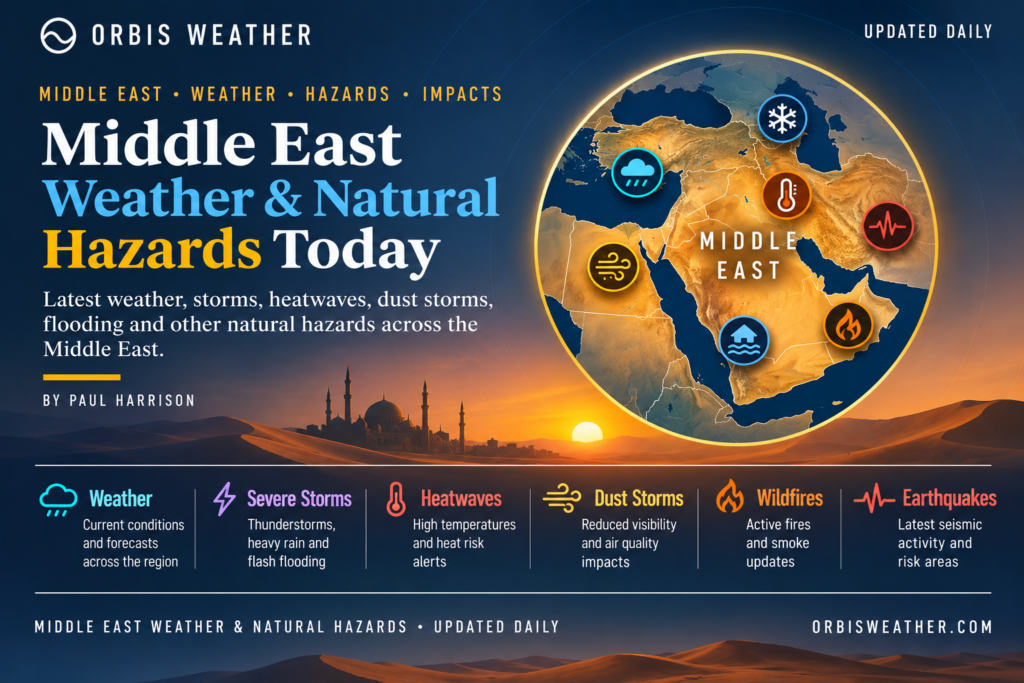
🌍 Middle East Weather & Natural Hazards Today

No news articles published today yet.





Middle East Weather & Natural Hazards – Nov 26, 2026
Middle East Weather & Natural Hazards Today
Regional Weather Intelligence & Natural Hazard Monitoring
The Middle East is approaching December with increasingly varied seasonal weather conditions. Cooler temperatures across northern territories contrast with warmer conditions across the Arabian Peninsula, while Mediterranean weather systems, desert dust, mountain snowfall and seismic activity remain important concerns.
In the United Arab Emirates, forecasts indicate a slight reduction in temperatures, with intermittent cloud cover and possible light rainfall across some coastal and island locations. Overnight humidity may also contribute to reduced visibility during the early morning.
🌍 Today's Main Weather & Hazard Headlines
🌧️ UAE Rainfall
ForecastPossible light rainfall across selected islands, coastal areas and western districts.
🌫️ Fog & Mist
ForecastIncreasing overnight humidity could produce reduced visibility across coastal and inland UAE communities.
🌍 Earthquake Monitoring
Ongoing monitoringTürkiye, Iran and surrounding tectonically active regions remain important areas for seismic monitoring.
❄️ Mountain Weather
Seasonal riskCold temperatures, snowfall and icy roads remain seasonal concerns across higher northern elevations.
🏜️ Desert Dust
Seasonal riskStrong desert winds can generate blowing dust and deteriorating air quality across exposed locations.
🌊 Flash Flooding
Seasonal riskDry riverbeds, mountain valleys and poorly drained urban areas remain vulnerable during intense rainfall.
Motorists should monitor local visibility forecasts, particularly during overnight and early-morning travel. Never attempt to cross flooded roads or wadis. This regional report does not replace official emergency warnings.
🇦🇪 United Arab Emirates
The UAE National Centre of Meteorology outlook for Thursday indicates partly cloudy conditions, with intermittent thicker cloud cover and possible light rainfall across some coastal and island locations.
Temperatures are expected to decrease slightly, while overnight humidity may produce fog or mist into Friday morning.
| Weather factor | November 26 outlook |
|---|---|
| 🌤️ Sky conditions | Fair to partly cloudy, occasionally cloudy |
| 🌧️ Rainfall | Possible localized light rain |
| 🌡️ Temperature trend | Slightly cooler |
| 💨 Winds | Generally light to moderate |
| 🌫️ Visibility | Localized overnight fog or mist possible |
| 🌊 Marine conditions | Generally slight, with moderate conditions possible |
Source: UAE National Centre of Meteorology and Gulf News weather forecast.
🇸🇦 Saudi Arabia
Late November marks the transition toward cooler winter conditions across Saudi Arabia. Northern and central desert regions typically experience increasingly cool nights, while coastal communities remain comparatively mild.
Hazards to monitor:
- 🏜️ Blowing dust across desert highways.
- ⛈️ Thunderstorms over western mountain regions.
- 🌊 Rapid flooding in valleys following heavy rainfall.
- 🌡️ Significant day-to-night temperature differences.
Saudi National Center for Meteorology
🇴🇲 Oman
Oman's principal seasonal vulnerabilities include localized mountain rainfall, coastal humidity and flash flooding within steep valleys. Weather conditions around the Hajar Mountains can change rapidly when thunderstorms develop.
Mariners should also monitor conditions across the Sea of Oman and Arabian Sea.
🇶🇦 Qatar, 🇧🇭 Bahrain & 🇰🇼 Kuwait
November generally brings more comfortable temperatures across the northern Gulf states. Overnight humidity, fog, dust and stronger northwesterly winds remain potential disruptions to road and marine transport.
Residents should follow national forecasts for any developing rainfall or reduced-visibility advisories.
🇮🇶 Iraq
Iraq is entering its cooler and generally wetter winter season. Northern mountainous districts are particularly vulnerable to falling temperatures, while rainfall can generate localized flooding in urban and low-lying areas.
Dust events remain possible when strong winds cross dry terrain. These are seasonal concerns rather than confirmed active warnings for Thursday.
🇮🇷 Iran
Iran's mountainous geography produces considerable differences in regional weather. Higher elevations of the Zagros and Alborz mountain ranges are susceptible to winter snowfall and icy conditions, while southern coastal regions generally remain warmer.
Earthquake monitoring remains particularly important because of Iran's location within an active continental collision zone.
🇹🇷 Türkiye
Türkiye is approaching the winter season, when Mediterranean weather systems can deliver substantial rainfall to western and coastal districts. Interior and eastern mountain regions become increasingly vulnerable to frost, snowfall and hazardous road conditions.
Seismic activity also remains an ongoing natural hazard throughout the country.
Turkish State Meteorological Service
🇮🇱 Israel, 🇵🇸 Palestinian Territories, 🇱🇧 Lebanon, 🇯🇴 Jordan & 🇸🇾 Syria
The eastern Mediterranean is entering its traditional winter rainfall season. Developing weather systems can bring showers, thunderstorms, gusty winds and localized flooding.
Communities with inadequate drainage, damaged infrastructure or temporary shelter are particularly vulnerable during prolonged rainfall and cold overnight conditions.
Higher elevations of Lebanon and Syria face increasing seasonal risks from frost and mountain snowfall.
🇾🇪 Yemen
Despite its predominantly arid climate, Yemen remains vulnerable to localized heavy rainfall, mountain runoff and flash flooding whenever thunderstorms develop.
Coastal communities should monitor marine forecasts, while humanitarian conditions can increase vulnerability to otherwise manageable weather events.
🌡️ Typical Late-November Temperatures
The following figures are approximate seasonal daytime temperature ranges for general context. They are not verified forecasts for November 26.
| City | Fahrenheit | Celsius |
|---|---|---|
| 🇦🇪 Dubai | 79–88°F | 26–31°C |
| 🇦🇪 Abu Dhabi | 79–88°F | 26–31°C |
| 🇸🇦 Riyadh | 73–82°F | 23–28°C |
| 🇸🇦 Jeddah | 86–93°F | 30–34°C |
| 🇴🇲 Muscat | 82–90°F | 28–32°C |
| 🇶🇦 Doha | 79–86°F | 26–30°C |
| 🇧🇭 Manama | 75–84°F | 24–29°C |
| 🇰🇼 Kuwait City | 70–81°F | 21–27°C |
| 🇮🇶 Baghdad | 64–75°F | 18–24°C |
| 🇮🇷 Tehran | 50–61°F | 10–16°C |
| 🇹🇷 Istanbul | 50–61°F | 10–16°C |
| 🇹🇷 Ankara | 43–54°F | 6–12°C |
| 🇯🇴 Amman | 59–70°F | 15–21°C |
| 🇱🇧 Beirut | 64–73°F | 18–23°C |
| 🇮🇱 Tel Aviv | 68–77°F | 20–25°C |
🌍 Earthquake & Seismic Activity
The Middle East contains several active tectonic boundaries associated with the Arabian, Eurasian and Anatolian plates.
Regions requiring continuous earthquake monitoring include:
- Türkiye — North and East Anatolian fault systems.
- Iran — Zagros Mountains and northern fault systems.
- Iraq — northeastern border regions.
- Eastern Mediterranean — offshore tectonic zones.
- Jordan and surrounding territories — Dead Sea Transform.
No independently verified November 26 earthquake inventory was available when this edition was prepared. Consult live seismic feeds for the latest confirmed events.
🌍 USGS Live Earthquake Map
🌍 European-Mediterranean Seismological Centre
🌀 Arabian Sea Tropical Weather
November falls within the post-monsoon tropical cyclone season across the northern Indian Ocean. Although tropical development does not occur every day, the Arabian Sea remains a basin worth monitoring.
Any developing tropical system could potentially affect marine traffic and coastal communities in Oman, Yemen or neighboring regions, depending on its track and intensity.
Current cyclone activity has not been independently verified for this edition.
India Meteorological Department — Tropical Cyclone Monitoring
🔥 Wildfires, Dust & Air Quality
Dry landscapes throughout the Middle East remain susceptible to localized fires, particularly where dry vegetation and strong winds combine.
Air quality can also deteriorate because of mineral dust, urban pollution and smoke. Individuals with respiratory conditions should consult local air-quality observations before prolonged outdoor activity.
NASA FIRMS — Global Fire Monitoring
⚠️ Regional Natural Hazard Dashboard
| Natural Hazard | Areas to Monitor | Assessment |
|---|---|---|
| 🌧️ Rainfall | United Arab Emirates | Forecast possibility |
| 🌫️ Fog | UAE coastal and inland areas | Forecast possibility |
| 🌊 Flash flooding | Oman, Yemen, Saudi Arabia, Iraq, Levant | Seasonal risk |
| 🌍 Earthquakes | Türkiye, Iran, Iraq, eastern Mediterranean | Ongoing monitoring |
| ❄️ Snow and ice | Türkiye, Iran, northern Iraq | Seasonal risk |
| 🏜️ Dust storms | Saudi Arabia, Kuwait, Iraq and Iran | Seasonal risk |
| 🔥 Wildfires | Dry vegetation regions | Live status unverified |
| 🌀 Tropical cyclones | Arabian Sea | Live status unverified |
Dashboard categories identify forecast possibilities, seasonal vulnerabilities and monitoring requirements. They do not represent official warning levels or confirmed active disasters.
📅 Weather Outlook: November 27–29
Friday, November 27
🌦️ Possible intermittent light rainfall and overnight fog across parts of the UAE, according to the available forecast.
Saturday, November 28
🌫️ Monitor morning visibility across Gulf countries and updated Mediterranean rainfall forecasts.
Sunday, November 29
❄️ Continue monitoring mountain temperatures, winter precipitation and potential desert wind events. Detailed forecasts remain subject to verification.
📡 Official Weather & Natural Hazard Sources
- World Meteorological Organization (WMO)
- UAE National Centre of Meteorology
- Saudi National Center for Meteorology
- Turkish State Meteorological Service
- United States Geological Survey (USGS)
- European-Mediterranean Seismological Centre
- Global Disaster Alert and Coordination System
- NASA FIRMS Wildfire Monitoring
- Regional Specialized Meteorological Centre — New Delhi
🌐 Orbis Weather Summary
Possible light rainfall, cooler temperatures and localized fog across the United Arab Emirates are the principal verified forecast developments featured in today's regional edition.
Elsewhere, attention remains focused on seasonal Mediterranean rainfall, desert dust, mountain winter weather, flash-flood vulnerability and ongoing earthquake monitoring.
As November approaches its conclusion, residents and travelers should remain informed through their national meteorological services and local emergency management authorities.
📝 Editorial Methodology
Prepared: November 25, 2026, for the November 26 regional edition.
Orbis Weather distinguishes between published weather forecasts, confirmed observations, approximate seasonal temperature ranges and general hazard-monitoring guidance. Unverified events are not presented as confirmed disasters.
This report is an editorial regional overview, not an automated live-data feed. Conditions and official warnings may change after publication.
For official emergency instructions, always consult the relevant national meteorological and disaster management authorities.
For corrections or clarification, please contact Orbis Weather through our website.
About the Author
Paul Harrison — Founder & Publisher, Orbis Weather
Paul Harrison founded Orbis Weather in 2026 to make global weather and natural-hazard information easier to find, follow and understand. His coverage includes tropical cyclones, severe weather, extreme temperatures, earthquakes, volcanoes, wildfires, flooding and significant natural disasters worldwide.
View all articles by Paul Harrison → | Editorial Standards →
Global Weather Tracker Hub
Explore weather maps, tropical systems, storms and natural hazards around the world.
No matching trackers found.