
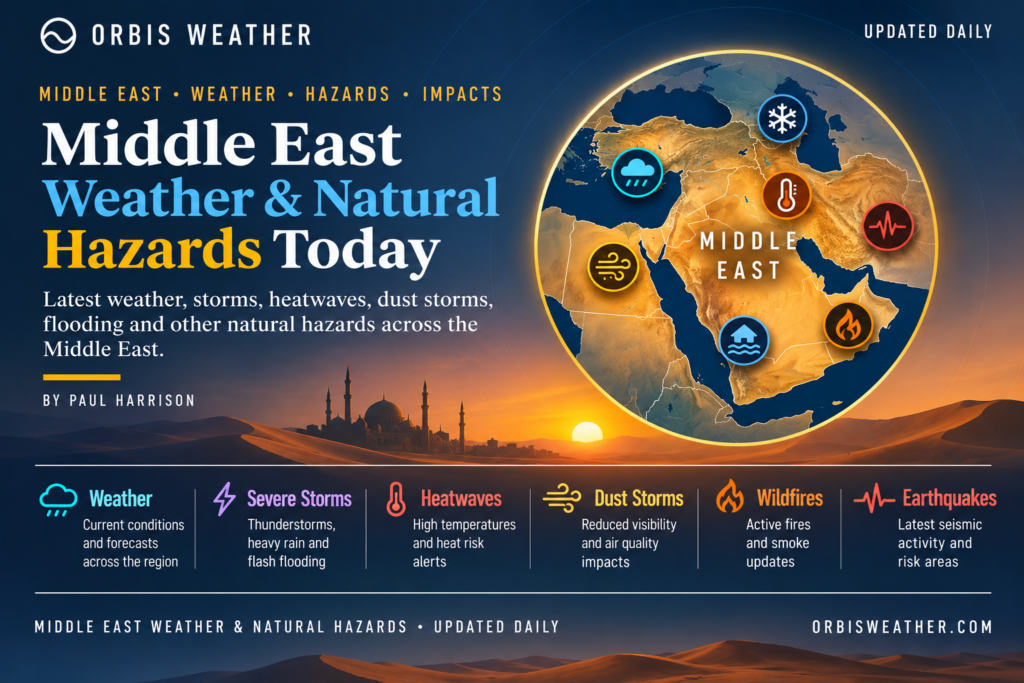
🌍 Middle East Weather & Natural Hazards Today

No news articles published today yet.





Middle East Weather & Natural Hazards Today – Tuesday, November 17, 2026
Saudi Arabia Monitors Flash-Flood Threats, UAE Forecasts Coastal Showers, and Winter Weather Risks Grow Across the Eastern Mediterranean
By Paul Harrison | Orbis Weather | Tuesday, November 17, 2026
Middle East Weather Overview
The Middle East enters Tuesday, November 17, with attention focused on the aftermath of severe thunderstorms in Saudi Arabia, developing cloud and rainfall conditions across the United Arab Emirates, and increasing seasonal weather risks across Iraq, Iran and the eastern Mediterranean.
Saudi Arabia remains an important area to monitor following several days of severe-weather warnings involving thunderstorms, hail, strong winds and flash flooding. Although the earlier warnings covered November 10–14, the possibility of lingering floodwater and disrupted roads makes local conditions important for travelers.
In the United Arab Emirates, a more specific forecast is available for Tuesday. The National Centre of Meteorology expects partly cloudy to cloudy conditions, with a chance of light rainfall over islands and some northern and coastal districts. Winds may occasionally strengthen, although relatively slight seas are forecast.
Farther north, the approach of winter is increasing the importance of rainfall preparedness, particularly in mountainous communities, flood-prone valleys and areas where infrastructure is already vulnerable.
The principal regional weather concerns for Tuesday are:
Saudi Arabia: Residual flash-flood hazards and monitoring for renewed thunderstorms.
United Arab Emirates: Possible light coastal rainfall, changing winds and variable cloud cover.
Iran and Iraq: Flood recovery, mountain conditions and the possibility of further seasonal rainfall.
Lebanon, Syria, Jordan, Israel and Palestine: Winter rainfall preparedness, colder conditions and localized flooding risks.
Oman and Yemen: Potential flash flooding in wadis and mountainous terrain whenever heavy showers develop.
This report distinguishes confirmed forecasts and previously documented weather events from seasonal hazards. A monitoring concern does not necessarily indicate that an active warning has been issued for November 17.
1. Saudi Arabia – Flash Flooding and Thunderstorm Recovery
Saudi Arabia remains one of the Middle East’s most important weather-monitoring areas following a period of significant instability.
Earlier in November, Saudi Civil Defense issued severe-weather alerts affecting seven regions: Riyadh, Makkah, Madinah, Asir, Jazan, Hail and Qassim.
The warnings involved heavy thunderstorms, hail, damaging wind gusts, reduced visibility and the potential for dangerous flash flooding. The original alert period extended through November 14.
Areas requiring attention Tuesday
Makkah and Madinah: Roads crossing valleys and drainage channels can remain dangerous after significant rainfall. Pilgrims and travelers should check local conditions before departure.
Asir and Jazan: Mountainous terrain increases the danger of rapid runoff, unstable slopes and sudden changes in visibility.
Riyadh and Qassim: Urban drainage and exposed highways require monitoring if further thunderstorms develop.
Hail and northern districts: Changes in wind direction, cloud cover and rainfall may affect road conditions.
Eastern Province: Blowing dust remains a potential hazard during periods of stronger winds.
Tuesday outlook
The main concern is whether any additional rainfall develops over districts affected by earlier storms.
A new nationwide severe-weather alert specifically covering Tuesday, November 17, has not been independently verified for this report.
Residents should monitor the Saudi National Center for Meteorology and Civil Defense for updated district-level warnings.
2. United Arab Emirates – Coastal Rainfall Possible Tuesday
The United Arab Emirates has a clearer short-term forecast for November 17, with the National Centre of Meteorology predicting partly cloudy to cloudy skies and a chance of light showers over some islands, northern areas and coastal districts.
FORECAST HIGHS FOR TUESDAY, NOVEMBER 17
Dubai
88°F
31°C
Low: 75°F / 24°CAbu Dhabi
90°F
32°C
Low: 70°F / 21°CSharjah
88°F
31°C
Low: 73°F / 23°CWinds are forecast at approximately 10–25 km/h (6–16 mph), occasionally reaching 35 km/h (22 mph). Seas are expected to remain slight in the Arabian Gulf and the Oman Sea.
Main weather concerns
Dubai and Abu Dhabi may experience changing cloud cover, while coastal and northern districts have a greater chance of isolated showers.
Motorists should remain alert for temporary reductions in visibility, particularly where showers develop.
Marine operators should continue monitoring updated coastal forecasts despite the relatively calm sea outlook.
Tuesday assessment: Light rainfall and changing winds are the principal forecast developments. The available forecast does not establish a widespread severe-weather emergency.
3. Iran – Mountain Weather, Flooding and Earthquake Hazards
Iran enters Tuesday with attention focused on seasonal rainfall, mountain travel and communities vulnerable to flash flooding.
The Zagros Mountains and western provinces are particularly sensitive to heavy rainfall because steep terrain can accelerate runoff into valleys and settlements.
Principal natural hazards
Western Iran: Heavy rain, when present, can produce flash flooding, landslides and road closures.
Tehran and northern Iran: Seasonal changes may bring colder nights, mountain fog and deteriorating conditions at higher elevations.
Southern Iran: Dust, reduced visibility and occasional rainfall remain weather considerations.
Earthquake risk: Iran lies within a highly active tectonic region. Seismic monitoring remains important throughout the year.
Tuesday assessment
No new nationwide flood emergency or major earthquake specifically for November 17 has been independently verified in the sources reviewed.
Mountain travelers should consult local weather forecasts and road authorities before departure.
4. Iraq – Flood Recovery and Seasonal Rainfall Risks
Iraq remains vulnerable to flooding as the country moves further into its wetter season.
Earlier November rainfall demonstrated how quickly intense downpours can disrupt transport, overwhelm drainage infrastructure and affect low-lying communities.
Areas to monitor
Baghdad: Heavy showers can overwhelm urban drainage systems, particularly where roads and stormwater channels are already compromised.
Mosul and northern Iraq: Valleys and mountainous terrain increase the potential for rapid runoff during thunderstorms.
Kurdistan Region: Steep slopes create additional concerns involving landslides, falling rocks and hazardous mountain roads.
Basra and southern Iraq: Low-lying neighborhoods may experience drainage problems following intense rainfall.
Tuesday outlook
The priority is monitoring updated rainfall forecasts and checking whether roads and infrastructure affected by earlier flooding have recovered.
A new nationwide severe-weather warning for Tuesday has not been independently confirmed.
5. Oman – Wadi Flooding and Mountain Hazards
Oman’s varied geography makes it particularly vulnerable to sudden changes in weather.
The Hajar Mountains, interior valleys and coastal settlements can experience dramatically different conditions within relatively short distances.
Main concerns
Muscat: Urban flooding during intense showers and changing coastal weather.
Sohar: Visibility, winds and marine conditions.
Nizwa and the Hajar Mountains: Rapid runoff, slippery mountain roads and potential rockfalls.
Southern Oman: Localized heavy showers and changing mountain conditions when moisture is available.
Wadis can fill rapidly even when rainfall occurs many kilometers upstream.
Tuesday assessment
There is no independently verified nationwide flash-flood emergency for November 17 in the material reviewed.
Residents and visitors should monitor Oman’s official meteorological service before entering remote valleys or mountainous areas.
6. Qatar, Bahrain and Kuwait – Winds, Visibility and Marine Conditions
Across the northern and central Gulf, November generally brings more comfortable temperatures and increasingly variable winds.
However, changing wind patterns can occasionally produce blowing dust, reduced visibility and rougher offshore conditions.
Qatar: Doha and surrounding coastal areas should monitor changing winds, humidity and marine forecasts.
Bahrain: Coastal and offshore activities can be affected by strengthening northwesterly winds.
Kuwait: Desert highways are vulnerable to reduced visibility when stronger winds lift dust and sand.
No widespread severe-weather emergency specifically for Tuesday has been verified for these three countries.
7. Lebanon – Winter Rainfall and Mountain Conditions
Lebanon is entering the part of the year when Mediterranean weather systems become increasingly important.
Rainfall is essential for water resources, but intense showers can cause problems in urban districts and mountainous communities.
Areas requiring attention
Beirut and Tripoli: Localized flooding is possible when heavy rainfall overwhelms drainage systems.
Mount Lebanon: Fog, slippery roads and falling temperatures can complicate travel.
Bekaa Valley: Colder nighttime temperatures and changing rainfall patterns become increasingly relevant during November.
Higher mountain elevations may experience increasingly wintry conditions as the season progresses.
Tuesday outlook
The main concerns are seasonal rainfall preparedness and mountain-road safety.
A new nationwide severe-weather alert specifically for November 17 has not been independently confirmed.
8. Syria – Cold Weather and Flooding Risks for Vulnerable Communities
Syria faces significant weather-related challenges as winter approaches.
The combination of damaged infrastructure, inadequate shelter and seasonal rainfall increases the consequences of even relatively modest weather events.
Main hazards
Northern Syria: Rainfall can turn unpaved roads into mud, disrupting transport and access to essential services.
Western Syria: Mediterranean weather systems may bring periods of rain and stronger winds.
Mountainous districts: Falling temperatures, fog and slippery roads can create travel hazards.
Displacement camps: Heavy rain can damage temporary shelters, flood access routes and increase exposure to cold conditions.
Humanitarian concerns
Weather-related disruption can be especially serious for families living in temporary accommodation or buildings with limited protection against rainfall.
Reliable drainage, heating, safe drinking water and emergency shelter remain important winter priorities.
No new nationwide weather disaster for Tuesday has been independently established.
9. Israel and Palestine – Seasonal Rainfall and Flood Exposure
The eastern Mediterranean is moving into its wetter season, bringing increasing opportunities for rainfall and occasional thunderstorms.
Israel and the West Bank
Coastal cities, including Tel Aviv and Haifa, can experience localized drainage problems during intense rainfall.
Inland valleys and desert areas are vulnerable to flash flooding, particularly around the Dead Sea and in narrow drainage channels.
Rainfall occurring upstream may produce dangerous flooding downstream, even where skies appear relatively clear.
Gaza – Winter Weather and Humanitarian Vulnerability
Weather conditions remain an important humanitarian concern in Gaza, where damaged infrastructure and inadequate shelter can magnify the consequences of rainfall.
Potential hazards include:
Flooding of temporary accommodation.
Water accumulating around damaged buildings.
Muddy or inaccessible roads.
Contamination of standing water.
Exposure to colder nighttime temperatures.
These are significant seasonal vulnerabilities, but a new widespread flooding event specifically on November 17 has not been independently confirmed.
10. Jordan – Flash Flooding in Desert Valleys
Jordan’s rugged landscapes and normally dry riverbeds can become hazardous when heavy rainfall develops.
Amman: Urban drainage problems may occur during intense showers.
Petra: Narrow valleys can rapidly channel floodwater, creating dangerous conditions for visitors.
Wadi Rum: Flash flooding can affect desert tracks and camping areas.
Dead Sea region: Steep drainage channels can transport floodwater from rainfall occurring farther inland.
Tuesday outlook
Visitors should monitor rainfall forecasts across entire catchment areas rather than relying solely on conditions at their immediate location.
A new nationwide flash-flood warning for November 17 has not been independently verified.
11. Yemen – Flash Flooding, Landslides and Infrastructure Risks
Yemen remains highly vulnerable to natural hazards because of its mountainous terrain, seasonal rainfall patterns and damaged infrastructure.
Main areas of concern
Sana’a and surrounding highlands: Heavy rainfall can produce rapid runoff and localized flooding.
Taiz and western mountains: Steep slopes increase landslide and road-collapse risks during prolonged rain.
Aden and coastal areas: Drainage problems and occasional intense rainfall can disrupt transportation.
Remote communities: Damaged roads and bridges can delay emergency assistance following severe weather.
Tuesday assessment
The principal concern remains the vulnerability of communities and infrastructure if heavy rainfall develops.
No new nationwide flooding disaster specifically for November 17 has been independently verified.
12. Middle East Natural Hazards Summary – November 17, 2026
Country or region | Main concern | Current assessment |
|---|---|---|
Saudi Arabia | Thunderstorms, hail, flash flooding | Recent official warnings; continued monitoring |
United Arab Emirates | Light coastal showers, changing winds | Tuesday forecast confirmed |
Iran | Mountain rainfall, flooding, earthquakes | Seasonal monitoring |
Iraq | Flood recovery, urban drainage | Continued monitoring |
Oman | Wadi flooding, mountain roads | Conditional risk |
Qatar | Wind and marine conditions | Routine monitoring |
Bahrain | Winds and coastal conditions | Routine monitoring |
Kuwait | Dust and reduced visibility | Routine monitoring |
Lebanon | Rainfall, mountain fog | Seasonal preparedness |
Syria | Rain, cold-weather exposure | Humanitarian vulnerability |
Israel and Palestine | Flooding and winter exposure | Seasonal preparedness |
Jordan | Desert flash flooding | Conditional risk |
Yemen | Flooding and landslides | Continuing vulnerability |
This table is a regional hazard assessment, not a list of active November 17 warnings. Confirmed Tuesday-specific forecast information is available for the UAE; most other entries describe recent events or established seasonal vulnerabilities.
13. Earthquake and Geological Hazards
The Middle East lies across several important tectonic boundaries, making earthquake monitoring an essential part of regional natural-hazard reporting.
Iran
The Zagros mountain belt and other fault systems remain seismically active. Earthquakes can affect mountainous communities, roads and buildings.
Turkey and northern Syria
The East Anatolian Fault system and surrounding tectonic structures create persistent earthquake hazards.
Israel, Palestine and Jordan
The Dead Sea Transform fault system is an important source of regional seismic risk.
Arabian Peninsula
Although much of the Arabian Peninsula is less seismically active than Iran or Turkey, western Saudi Arabia and areas around the Red Sea contain active geological structures.
Earthquake status: No verified list of significant earthquakes specifically occurring on November 17 was available for this edition. Readers should consult the US Geological Survey for the latest recorded events.
14. Regional Weather Outlook – Next 24 to 48 Hours
Arabian Peninsula
Recent storm activity in Saudi Arabia makes the western and southwestern highlands important monitoring areas. Updated forecasts are needed to establish whether further thunderstorms will develop.
The UAE’s confirmed Tuesday outlook indicates variable cloud cover and a chance of light coastal rainfall.
Northern Middle East
Iraq and Iran should continue monitoring changing seasonal weather, particularly in mountain districts and areas affected by earlier rainfall.
Eastern Mediterranean
Lebanon, Syria, Israel, Palestine and Jordan are entering a period when Mediterranean rainfall systems become increasingly relevant.
Communities with vulnerable drainage, temporary shelter or exposed mountain roads should prepare for changing conditions.
Gulf marine conditions
Boaters, fishing crews and offshore operators should check the latest local marine bulletins.
The UAE forecast indicates relatively slight seas on Tuesday, but this should not be interpreted as a forecast for every part of the Gulf.
15. Weather Safety Advice
During unsettled weather, residents and travelers should follow several important precautions:
Never drive through flowing floodwater or attempt to cross a flooded wadi.
Avoid camping in dry riverbeds when thunderstorms are possible upstream.
Check mountain-road conditions before traveling.
Reduce driving speed during heavy rain, fog or blowing dust.
Monitor official marine forecasts before boating or fishing.
Keep emergency supplies available in areas vulnerable to flooding or isolation.
Follow evacuation instructions and emergency announcements issued by local authorities.
Flash flooding can remain dangerous after rainfall has ended, particularly where roads, bridges and drainage infrastructure have been damaged.
16. Official Weather and Natural Hazard Sources
Orbis Weather recommends the following organizations for forecasts, warnings and emergency information.
Organization | Information |
|---|---|
Saudi weather forecasts and alerts | |
UAE forecasts and marine conditions | |
Weather forecasts and warnings | |
Qatar forecasts | |
Earthquake monitoring | |
International weather information | |
Humanitarian emergencies |
Recent reporting and forecast information reviewed
Saudi National Center for Meteorology, November 16, 2026: Official forecast identifying continued moderate to heavy thunderstorms over Jazan, Asir, Al-Baha and Makkah, with potential torrential runoff and hail.
National Center For MeteorologyKhaleej Times, November 16, 2026: UAE National Centre of Meteorology forecast for Tuesday, November 17, including light rainfall potential, wind speeds and temperatures.
Khaleej TimesSaudi Gazette, November 12, 2026: Thunderstorm and flash-flood forecasts across Jazan, Asir, Al-Baha and Makkah.
Saudi GazetteSaudi Gazette, November 10, 2026: Civil Defense red alerts affecting seven Saudi regions.
Saudi Gazette
17. Orbis Weather Final Outlook – Tuesday, November 17, 2026
Saudi Arabia remains the Middle East’s leading severe-weather monitoring priority following successive days of thunderstorms, hail and flash-flood warnings.
The official November 16 forecast continued to identify the possibility of heavy thunderstorms and torrential runoff in Jazan, Asir, Al-Baha and Makkah. Whether those conditions persist into Tuesday requires a fresh local bulletin.
The United Arab Emirates is expecting a comparatively less severe weather pattern, with variable cloud cover, possible light coastal showers and occasional strengthening winds.
Across Iran and Iraq, attention remains focused on flood recovery, mountain conditions and changing seasonal weather.
Farther west, the approach of winter increases the importance of rainfall preparedness across Lebanon, Syria, Jordan, Israel and Palestine, especially where communities face damaged infrastructure or inadequate shelter.
The main message for Tuesday: Monitor official weather alerts, remain cautious around flood-prone valleys and mountain roads, and avoid assuming that improving skies mean flood hazards have disappeared.
Orbis Weather provides independent weather reporting, regional hazard analysis and public-safety information. This article is based on available meteorological forecasts, recent reporting and established natural-hazard information. It does not replace official emergency warnings. Forecasts and conditions can change rapidly.
Published by Orbis Weather | Paul Harrison | November 17, 2026
About the Author
Paul Harrison — Founder & Publisher, Orbis Weather
Paul Harrison founded Orbis Weather in 2026 to make global weather and natural-hazard information easier to find, follow and understand. His coverage includes tropical cyclones, severe weather, extreme temperatures, earthquakes, volcanoes, wildfires, flooding and significant natural disasters worldwide.
View all articles by Paul Harrison → | Editorial Standards →
Global Weather Tracker Hub
Explore weather maps, tropical systems, storms and natural hazards around the world.
No matching trackers found.