
Winter Weather Europe




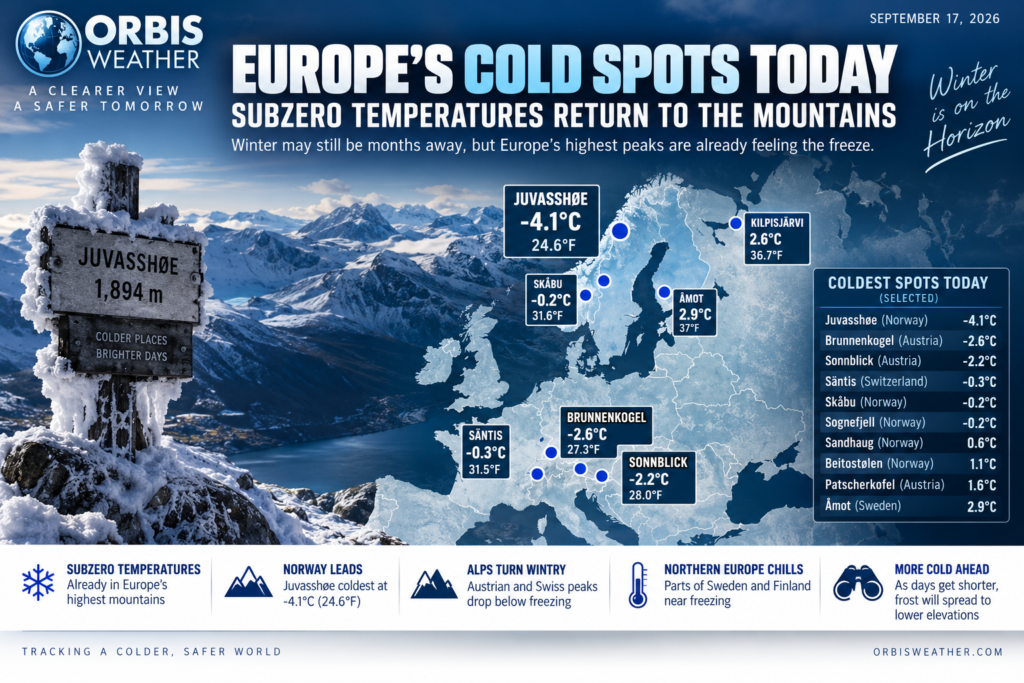

🥶 Europe’s Cold Spots Today: Subzero Temperatures Return to the Mountains
September 17, 2026 — Orbis Weather
Winter may still be several months away on the calendar, but some corners of Europe are already experiencing a distinctly wintry chill.
Early-morning observations across Europe show subzero temperatures at several high-elevation weather stations, while colder valleys and northern communities across Scandinavia are slipping toward the freezing mark.
The coldest verified readings available to Orbis Weather this morning are coming from the mountains of Norway and Austria, where temperatures have fallen well below 0°C (32°F).
🌡️ Europe’s Coldest Spots Today
Here are some of the standout low temperatures reported for September 17, 2026:
| Location | Country | Elevation | Low Temperature |
|---|---|---|---|
| 🥶 Juvasshøe | 🇳🇴 Norway | 1,894 m | -4.1°C / 24.6°F |
| ❄️ Brunnenkogel | 🇦🇹 Austria | 3,440 m | -2.6°C / 27.3°F |
| ❄️ Sonnblick | 🇦🇹 Austria | 3,111 m | -2.2°C / 28.0°F |
| 🧊 Säntis | 🇨🇭 Switzerland | 2,490 m | -0.3°C / 31.5°F |
| 🧊 Skåbu | 🇳🇴 Norway | 928 m | -0.2°C / 31.6°F |
| 🧊 Sognefjell | 🇳🇴 Norway | 1,413 m | -0.2°C / 31.6°F |
| 🌡️ Sandhaug | 🇳🇴 Norway | 1,250 m | 0.6°C / 33.1°F |
| 🌡️ Beitostølen | 🇳🇴 Norway | 965 m | 1.1°C / 34.0°F |
| 🌡️ Patscherkofel | 🇦🇹 Austria | 2,252 m | 1.6°C / 34.9°F |
| 🌡️ Bjorli | 🇳🇴 Norway | — | 2.5°C / 36.5°F |
These are selected verified stations rather than a definitive ranking of every observing site in Europe. Weather networks update at different times, and extremely high mountain stations naturally compete with Arctic locations for the lowest readings.
🥶 Cold Spot of the Day: Juvasshøe, Norway
🇳🇴 JUVASSHØE — -4.1°C / 24.6°F
Norway takes today’s Orbis Weather Europe Cold Spot title among the stations reviewed.
Juvasshøe, sitting at approximately 1,894 meters above sea level, dropped to -4.1°C (24.6°F).
That’s a genuinely wintry temperature for mid-September and a reminder that winter conditions can arrive remarkably early in Europe’s high mountains.
🇳🇴 Norway Shows Its Winter Side
Norway produced several of today’s most impressive cold readings.
Besides Juvasshøe, Skåbu fell to -0.2°C (31.6°F), while the Sognefjell mountain station also reached -0.2°C. Sandhaug dipped to just 0.6°C (33.1°F) and Beitostølen reached 1.1°C (34°F).
These temperatures show an important feature of early-season European cold: elevation can matter as much as latitude.
High terrain cools rapidly, while valleys can trap dense cold air overnight and occasionally produce frost even when nearby lower-elevation cities remain considerably warmer.
🏔️ Austrian Alps Drop Below Freezing
The Austrian Alps are also beginning to look increasingly wintry.
At Brunnenkogel, more than 3,400 meters above sea level, the temperature dropped to approximately -2.6°C (27.3°F).
Sonnblick, another famous high Alpine observing station at 3,111 meters, recorded approximately -2.2°C (28°F).
Patscherkofel reached 1.6°C (34.9°F).
While these temperatures aren’t unusual for such elevations, they illustrate how quickly the atmosphere cools with height—and why Europe’s highest mountains can experience winter conditions while valleys below remain relatively mild.
🇨🇭 Switzerland Joins the Freezing Club
Switzerland also recorded a subzero temperature this morning.
The Säntis weather station, at roughly 2,490 meters in the Appenzell Alps, dropped to approximately -0.3°C (31.5°F).
Lower elevations were dramatically warmer. Geneva recorded a low near 8.9°C (48°F), Zürich around 8.5°C (47°F) and Payerne approximately 7.6°C (46°F).
That contrast highlights the enormous effect elevation has on European temperatures during the transition from summer to autumn.
🇸🇪 Sweden: Chilly Valleys, but Not Yet Deep Winter
Sweden is cold in places this morning, although available observations don’t show the widespread freezing temperatures seen at Europe’s mountain stations.
Åmot reached approximately 2.9°C (37°F), putting parts of Sweden within striking distance of frost.
Farther north, forecasts around Abisko call for temperatures near or below freezing as colder air settles across northern Scandinavia, with even a small amount of snow possible.
🇫🇮 Finland: Lapland Turns Colder
Finland remains somewhat milder than Norway’s mountains this morning, but the coldest conditions are concentrated across Lapland and elevated terrain.
Kilpisjärvi Saana recorded approximately 2.6°C (36.7°F), while Kilpisjärvi was around 6.3°C (43.3°F). Other Lapland stations remained mostly in the upper single digits Celsius.
The trend is unmistakable: the far north is moving rapidly toward the season when freezing nights become routine.
❄️ Europe’s Seasonal Transition Is Accelerating
September is one of Europe’s great transition months.
Northern Europe rapidly loses daylight, nights become longer, and clear skies allow temperatures to fall much faster after sunset.
At the same time, the Alps and Scandinavian mountains begin experiencing increasingly frequent freezes.
Europe has also recently undergone a notable pattern change following late-summer warmth, with colder air spreading behind strong frontal systems earlier this month.
For most Europeans, this isn’t winter yet.
But above 2,000–3,000 meters, winter weather has already begun making appearances.
🔵 Orbis Weather Europe Cold Watch
🥶 Coldest observed station reviewed:
Juvasshøe, Norway — -4.1°C / 24.6°F
❄️ Second coldest:
Brunnenkogel, Austria — -2.6°C / 27.3°F
❄️ Third coldest:
Sonnblick, Austria — -2.2°C / 28.0°F
🏔️ Main cold zones:
Norwegian mountains • Austrian Alps • Swiss Alps • Northern Scandinavia
🌨️ Snow watch:
Highest Alpine elevations and portions of far northern Scandinavia
🔭 What Happens Next?
The next major milestone will be when freezing temperatures begin appearing more regularly away from Europe’s highest mountain stations.
Northern Scandinavia will be one of the first regions to watch.
As daylight rapidly decreases through late September and October, clear nights can allow temperatures to plunge below freezing across interior Norway, Sweden and Finland.
From there, Europe’s cold season gradually expands southward.
Today, though, the crown belongs to Norway.
🥶 Europe’s Cold Spot Today: Juvasshøe, Norway — -4.1°C / 24.6°F
Winter hasn’t officially arrived—but high above Europe’s valleys and cities, the first chapter is already being written.
Orbis Weather tracks winter weather, extreme temperatures, tropical cyclones, severe storms, floods, wildfires, earthquakes and volcanoes around the world.